
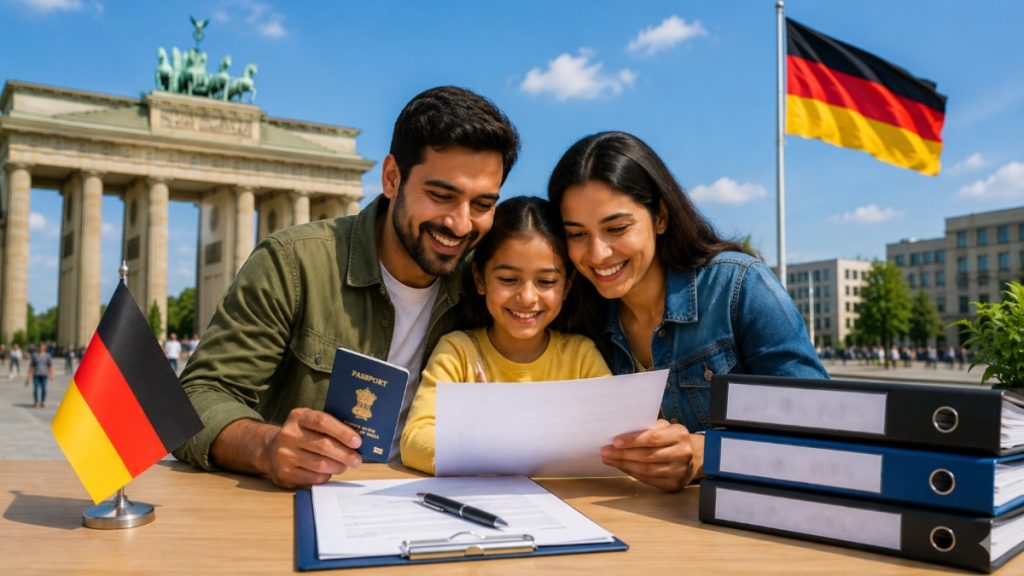
Being separated from the people you love most is never easy. Whether your spouse is building a career in Berlin, your partner is studying in Munich, or a family member has settled permanently in Hamburg, distance takes a toll.
The good news is that Germany has a clear, legal pathway that allows you to close that gap: the Germany Family Reunion Visa, also known as the Type D National Visa for Family Reunification.
This comprehensive guide covers everything you need to know about who qualifies, what documents you need, how the application process works, how long it takes, and what your life in Germany looks like once you arrive.
What Is the Germany Family Reunion Visa (Type D)?
The Germany Family Reunion Visa is a long-stay national visa (Category D) issued to non-EU family members who wish to join a relative legally residing in or a citizen of Germany.
Unlike a short-stay Schengen visa (Type C), which allows a maximum stay of 90 days, the Type D visa enables you to stay in Germany for 3 to 12 months and more importantly, it serves as your entry point to obtaining a German residence permit, which allows long-term or even permanent stay.
| Detail | Information |
|---|---|
| Visa Type | National Visa (Type D) |
| Purpose | Family Reunification |
| Validity | 3 to 12 months (entry visa) |
| Who Can Apply | Spouse, civil partner, or dependent child of a German resident/citizen |
| Visa Fee | €75 (adults), €37.50 (children under 18) |
| Processing Time | Approx. 3 months (varies by country) |
It is important to note that the Family Reunion Visa and the German Spouse Visa are related but separate categories. If you are joining a spouse or civil partner, a dedicated Spouse Visa may apply. This guide covers the broader Family Reunion Visa, which also includes dependent children and specific family configurations.
Who Is Eligible for the Germany Family Reunion Visa?
Not all family relationships qualify for this visa. German immigration law is specific about who can be sponsored for family reunification.
Eligible Family Members
1. Spouses and Civil Partners
The most common applicants are husbands, wives, and registered civil partners of:
- German citizens living in Germany
- Non-EU nationals holding a valid residence permit in Germany (e.g., work visa, student visa, permanent residency)
Both the applicant and the sponsor must be at least 18 years old at the time of application.
2. Dependent Minor Children
Children under the age of 18 who are unmarried and financially dependent can join their parent(s) in Germany. This includes:
- Biological children
- Adopted children
- Stepchildren (if they are minors, unmarried, and under the legal custody of the sponsor or their spouse)
Who Is NOT Eligible
1. Siblings not covered under family reunification
2. Adult children are generally not eligible unless in exceptional, documented circumstances
3. Parents are very difficult to sponsor; only possible in extreme cases of hardship, and you must prove full financial responsibility, including health insurance and all living expenses. Even then, approval is rare. If you are considering this route, consulting an immigration lawyer is strongly recommended.
Who Does NOT Need a Visa Before Travelling
Citizens of the following countries do not need to obtain a family reunion entry visa before arriving in Germany. They can travel to Germany first and then apply for a residence permit directly at the local Ausländerbehörde (Foreigners’ Office):
- Australia
- Canada
- United States of America
- United Kingdom
- Japan
- South Korea
- New Zealand
- Israel
All other nationalities must apply for the visa from their home country before travelling.
Requirements for the Germany Family Reunion Visa
Meeting the eligibility criteria is only the first step. Both the applicant and the sponsoring family member in Germany must meet a set of substantive requirements.
Requirements for the Applicant (Family Member Abroad)
1. Valid Passport: Your passport must be valid for the entire duration of your intended stay in Germany, with at least one blank page for the visa sticker.
2. German Language Proficiency – A1 Level: Spouses applying for a family reunion visa are generally required to demonstrate basic German language skills at the A1 level of the Common European Framework of Reference (CEFR). This means you should be able to introduce yourself, ask and answer basic questions, and understand simple, familiar expressions.
Accepted certificates include those from Goethe-Institut, telc GmbH, or ÖSD.
Exceptions to the A1 Language Requirement:
- Holders of a university degree or comparable qualification
- Spouses of EU Blue Card holders
- Spouses of highly skilled professionals
- Cases where obtaining an A1 certificate is demonstrably impossible or unreasonable
- Spouses of German citizens may sometimes be exempt in specific circumstances
3. Travel Health Insurance: You must have valid travel health insurance that covers your entire stay in Germany, at least until you are added to your family member’s health insurance plan after arrival.
Requirements for the Sponsor (Family Member in Germany)
1. Proof of Legal Status: The sponsor must prove they are legally residing in Germany. This means:
- A copy of their German passport or naturalisation certificate (for German citizens), or
- A copy of their valid residence permit (for non-EU residents)
2. Sufficient Financial Resources: Germany requires that the sponsor can financially support the incoming family member without relying on public welfare funds. Proof typically includes:
- The last three months’ payslips
- A current employment contract
- Bank statements or other proof of financial stability
The exact income threshold varies depending on family size and the state you live in, but as a general rule, the net household income must be sufficient to cover rent and living costs for all family members.
3: Adequate Accommodation The sponsor must show that the family home is large enough to accommodate all family members. Required documents:
- Current rental agreement showing the address and apartment size
- Or proof of property ownership
4: Registration Certificate (Meldebescheinigung) This official document confirms the sponsor’s registered address in Germany, obtained from the local Einwohnermeldeamt (Residents’ Registration Office).
Required Documents – Complete Checklist
Gathering the right documents is arguably the most important part of the application. Missing or incorrect paperwork is one of the most common reasons for delays and rejections.
Documents to Prepare
Applicant’s Documents:
- Completed and signed visa application form (printout from VIDEX or the embassy portal)
- Valid passport (original + photocopy of data page)
- Two recent biometric passport photos (35mm x 45mm, white background)
- Legalised and certified marriage certificate (for spouses)
- Legalised and certified birth certificate (for children)
- A1 German language certificate (original)
- Travel health insurance valid in Germany
- Visa fee: €75 for adults, €37.50 for children under 18
Sponsor’s Documents (copies to be submitted by applicant):
- Copy of sponsor’s German passport / identity card / naturalisation certificate (if German citizen)
- Copy of sponsor’s valid residence permit (if non-EU resident)
- Last three months’ payslips
- Current employment contract
- Rental agreement or proof of property ownership
- Meldebescheinigung (registration certificate confirming address)
Important: All documents in a language other than German must be accompanied by a certified German translation prepared by a sworn translator. Unofficial translations are not accepted.
Step-by-Step Application Process
Step 1: Gather Your Documents
Start by collecting all required documents well in advance. Allow extra time for legalisation, apostilles on foreign documents, and certified translations. Some documents, such as marriage certificates, may require legalisation through your country’s foreign affairs ministry and then authentication by the German embassy.
Step 2: Complete the Visa Application Form
You have two options:
- Online: Complete the application digitally via the VIDEX platform for long-stay visas, then print and sign it.
- Offline: Download the PDF form from the German embassy website, fill it out, and sign it manually.
Some German missions also offer a fully digital application portal via digital.diplo.de. If available in your country of residence, you can upload documents electronically, but you will still need to attend an in-person appointment for biometric data collection.
Step 3: Book a Visa Appointment
Contact the German embassy or consulate in your country of residence to schedule a visa appointment. This is often the most time-consuming step — waiting times for appointments can range from a few weeks to several months, depending on the embassy’s workload and your location.
Book as early as possible. Do not wait until you have all documents ready to start looking for an appointment. Book the slot first, then finalise your paperwork.
Step 4: Attend the Appointment and Submit Your Application
On the day of your appointment, bring all original documents plus copies. At the embassy, you will:
- Submit your full application package
- Pay the visa fee (€75 for adults, €37.50 for children under 18)
- Provide biometric data (fingerprints and photograph)
- Possibly answer questions about your relationship and circumstances
The fee is non-refundable, even if the visa is denied or you withdraw the application.
Step 5: Wait for the Decision
Once submitted, the embassy will process your application. Standard processing time is approximately 3 months, though this varies:
| Country | Approximate Processing Time |
|---|---|
| India | Minimum 3 months |
| China | Approximately 8 weeks |
| Other countries | Varies — check with the local embassy |
During this period, the embassy may contact you for additional documents. Respond promptly to avoid further delays.
Step 6: Receive Your Visa and Travel to Germany
If approved, the visa sticker will be affixed to your passport. It will specify the validity period (usually 3 to 12 months) and the entry dates. Travel to Germany within the validity window and begin the next phase: converting your visa to a residence permit.
After Arrival: Converting Your Visa to a Residence Permit
The Family Reunion Visa is an entry visa, not a permanent document. Once in Germany, you must apply for a residence permit (Aufenthaltstitel) before your visa expires, ideally at least four weeks before the expiry date.
Step-by-Step: Getting Your Residence Permit
1. Register Your Address (Anmeldung): Within two weeks of arriving in Germany, register your address at the local Einwohnermeldeamt (Residents’ Registration Office). You will receive a Meldebescheinigung (registration certificate), which is required for nearly all official processes in Germany.
2. Book an Appointment at the Ausländerbehörde: The Ausländerbehörde (Foreigners’ Office / Immigration Office) handles residence permits. Appointments can be booked online through your city’s official portal. In larger cities like Berlin or Munich, waiting times can be several weeks, so book early.
3. Prepare Your Documents: The exact document list will be provided by your local Ausländerbehörde, but typically includes:
- Your passport and visa
- Your Meldebescheinigung
- Your sponsor’s residence permit or German ID
- Proof of health insurance in Germany
- Proof of accommodation
- Proof of financial means
4. Submit Your Application and Pay the Fee: Attend your appointment, submit documents, and pay the residence permit fee (approximately €100).
Your residence permit will typically be valid for the same duration as your sponsor’s permit (e.g., if your spouse has a two-year work permit, yours will also be for two years) and can be renewed when the sponsor’s is renewed.
Your Rights in Germany with a Family Reunion Residence Permit
Once you hold a valid residence permit through family reunification, you enjoy significant rights in Germany, essentially the same as other legal residents.
Right to Work: You are fully authorised to work in Germany without any restrictions or a separate work permit. You can work full-time, part-time, or take up freelance work, in any industry or profession for which you are qualified.
Right to Study: You may enrol in schools, vocational programmes, or universities in Germany, provided you meet the entry and language requirements for the respective institution.
Access to Health Insurance: You will typically be co-insured under your family member’s statutory (public) health insurance plan, meaning you gain full access to Germany’s excellent public healthcare system.
Freedom of Movement Within Schengen: A German residence permit entitles you to travel freely within the Schengen Area for up to 90 days in any 180 days without needing additional visas.
Path to Permanent Residency: After three years of living in Germany on a family reunion residence permit, provided the family remains together, and other conditions are met, you may apply for a settlement permit (Niederlassungserlaubnis), which is Germany’s permanent residence status.
Path to German Citizenship: After five years of uninterrupted legal residence in Germany, you may be eligible to apply for German citizenship. Requirements include:
- Integration into German society
- Financial self-sufficiency
- German language skills at the C1 level
- No significant criminal record
Special Cases and Situations
- Spouses of EU Blue Card Holders: If your sponsor holds an EU Blue Card, the reunification process may be easier and faster. The A1 language requirement may be waived, and the waiting period may be shorter than in standard cases.
- Children Joining One Parent: If a child is joining only one parent in Germany (while the other parent lives in another country), additional documentation is required, including proof of custody and, in many cases, a notarised consent letter from the parent remaining abroad.
- Elderly Parents: Bringing parents to Germany is genuinely difficult. German law allows it only in cases of exceptional hardship, and you must demonstrate that you are fully financially responsible for them, including covering their health insurance without any public funds. Given the complexity, consulting a licensed immigration lawyer is strongly advisable for this category.
- Refugees and Beneficiaries of Subsidiary Protection: Family reunification for recognised refugees follows separate, more specific rules under German asylum law, and timelines and eligibility criteria differ significantly from the standard Type D visa path.
Common Reasons for Rejection (and How to Avoid Them)
Understanding why applications get rejected helps you prepare a stronger submission.
- Incomplete Documentation: The single most common cause of rejection. Go through the checklist multiple times and have a trusted person review your file before submission.
- Insufficient Proof of Income: If the sponsor’s income does not clearly meet the threshold needed to support the family, the application will be refused.
- Failure to Meet the A1 Language Requirement: Not having a recognised A1 certificate (unless an exception applies) will result in rejection.
- Inadequate Accommodation: German authorities require that the living space meet minimum standards for the number of family members.
- Inconsistencies in the Application. Any discrepancy between what you state and what documents show — dates, names, addresses — raises red flags.
Conclusion
Once you are in Germany with your family, the doors that open are significant — the right to work, to study, to access healthcare, and eventually a path to permanent residency and citizenship. For millions of families across the world, the Germany Family Reunion Visa has been the bridge that brought them back together. With the right information, it can be yours too.
Need Help With Your Germany Type D Visa?
Abroad Gateway has helped hundreds of families successfully reunite in Germany. Let our certified visa consultants handle the complexity — so you can focus on what matters. Get a Free Assessment.