
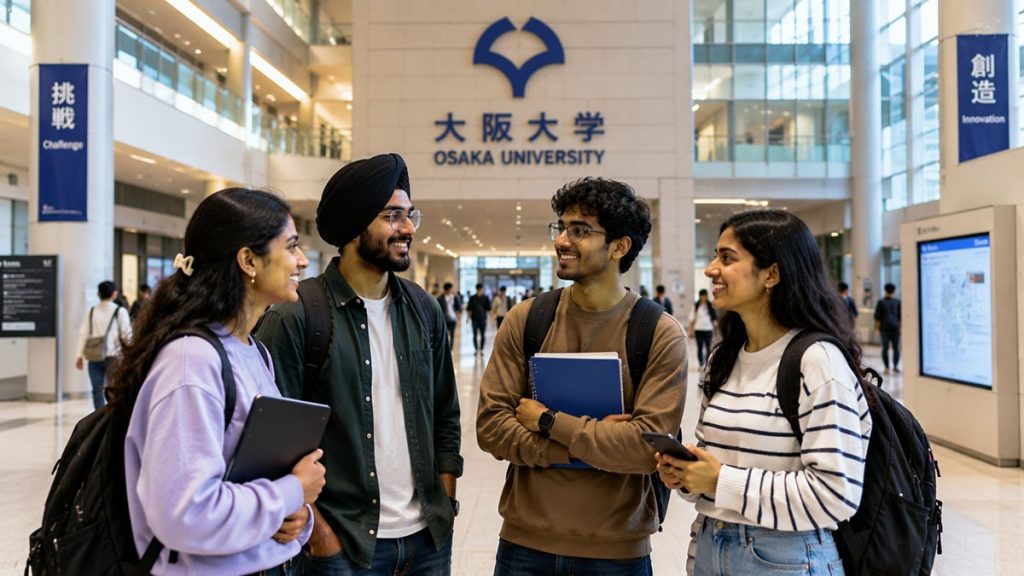
Japan has steadily risen to become one of Asia’s most sought-after study destinations, and for good reason. Home to globally ranked universities, cutting-edge research facilities, and a culture unlike any other, Japan offers international students an experience that combines academic excellence with personal growth.
For Indian students especially, Japan presents a compelling alternative to traditional destinations like the UK, Canada, or Australia, with growing English-taught programmes, generous scholarships, and a welcoming immigration framework.
This guide walks you through everything you need to know, from choosing a university to securing your student visa, so you can plan your study journey in Japan with clarity and confidence.
Why Study in Japan?
Japan’s appeal as a study destination goes well beyond its pop culture and cuisine. Here’s why thousands of international students choose Japan each year:
- World-Class Universities: The University of Tokyo, Kyoto University, and Osaka University consistently rank among the top 100 in the QS World University Rankings, offering research environments that rival the best in the world.
- Industry Connections: Japan’s universities maintain deep partnerships with global corporations like Sony, Toyota, Fujitsu, and Hitachi — giving students direct access to research projects, internships, and job placements.
- Growing English-Taught Programmes: Over 800 degree programmes in Japan are now offered entirely in English, making Japan accessible even for students without Japanese language proficiency.
- Safe and Affordable: Japan ranks among the world’s safest countries, and living costs outside Tokyo — especially in cities like Sendai, Osaka, and Nagoya — are significantly lower than in Western study destinations.
- Post-Study Work Opportunities: Japan actively encourages international graduates to stay and work, with a robust visa conversion pathway and a Highly Skilled Professional (HSP) route that fast-tracks permanent residency.
Top Universities in Japan for International Students
Japan has over 800 universities, but these institutions are particularly well-regarded among international students for their academic quality, global outlook, and English programme offerings:
| University | QS 2026 Rank | Popular Programs | Medium of Instruction | Annual Tuition Fee |
|---|---|---|---|---|
| University of Tokyo | #28 | Engineering, Science, Law, Medicine | English / Japanese | ¥535,800 (National) |
| Kyoto University | #46 | Life Sciences, Engineering, Humanities | English / Japanese | ¥535,800 (National) |
| Osaka University | #80 | Medicine, Engineering, Business | English / Japanese | ¥535,800 (National) |
| Tohoku University | #90 | Science, Technology, Research | English / Japanese | ¥535,800 (National) |
| Waseda University | #201–250 | Business, International Studies, Law | English | ¥1.2M–¥1.5M (Private) |
| Keio University | #201–250 | Economics, Policy, Engineering | English / Japanese | ¥1.0M–¥1.4M (Private) |
Source: QS World University Rankings 2025 (topuniversities.com)
Popular Courses & Fields of Study
Japan offers strong programmes across disciplines. The most popular fields among international students include:
- Engineering & Technology: Robotics, Mechanical, Electrical, and Computer Science programmes are world-leading, particularly at Tokyo, Tohoku, and Osaka.
- Business & Management: MBA and undergraduate business programmes at Waseda and Keio are increasingly taught in English and attract students from across Asia.
- Medicine & Life Sciences: Japan’s research output in biomedical sciences, pharmaceuticals, and public health is globally recognised.
- Arts, Design & Architecture: Institutions like Tokyo University of the Arts offer specialised creative programmes with global faculty networks.
- Japanese Language & Culture Studies: Ideal for students wanting to combine academic learning with deep cultural immersion and language acquisition.
Note: English-taught programmes have expanded significantly post-2020. However, proficiency in Japanese (JLPT N2 or higher) remains a strong advantage for campus life, part-time work, and post-study employment.
Eligibility & Admission Requirements
Requirements vary by institution and programme level, but the following are standard benchmarks:
- Undergraduate: Completion of 10+2 (or equivalent) with strong academic scores. Some programmes require entrance examinations.
- Postgraduate: A recognised Bachelor’s degree in a relevant field. Research proposals are required for doctoral programmes.
- Language Requirements: JLPT N2 or N1 for Japanese-medium programmes; IELTS 6.0–6.5 or TOEFL iBT 79–90 for English-medium programmes.
- Supporting Documents: Statement of Purpose (SOP), Letters of Recommendation (LORs), academic transcripts, and a valid passport.
- GRE/GMAT: Required for select postgraduate programmes in engineering, business, and science.
Application Timelines:
- April Intake (main intake): Apply between October and February of the preceding year.
- October Intake (secondary intake): Apply between April and June.
Scholarships to Study in Japan
Japan offers some of the most generous scholarships available to international students. Key options include:
| Scholarship | Provider | Monthly Stipend | Eligibility | Application Deadline |
|---|---|---|---|---|
| MEXT Scholarship | Government of Japan | ¥117,000–¥145,000 | All nationalities; high academic merit | May–June (via Embassy) |
| JASSO Scholarship | Japan Student Services Organization (JASSO) | ¥48,000 | Enrolled students in Japan | After arrival in Japan |
| Tobitate! Study Abroad | MEXT / Private Sector | Varies | Japanese students and returnees | Twice yearly |
| University Scholarships | Individual Universities | ¥20,000–¥100,000+ | Varies by institution | At the time of application |
| Honjo Foundation | Private Foundation | ¥180,000 | Graduate students with a research focus | November annually |
Source: MEXT (mext.go.jp), JASSO (jasso.or.jp)
Japan Student Visa: Step-by-Step Process
Japan does not accept direct student visa applications. The process is institution-led and follows a specific sequence:
- Receive Admission: Secure acceptance from a JASSO/Ministry of Justice (MOJ) recognised institution in Japan.
- Certificate of Eligibility (COE) Application: Your institution applies to the Immigration Services Agency of Japan on your behalf. This takes approximately 1–3 months.
- Receive COE: Once approved, the original COE document is sent to you by post.
- Apply at the Japanese Embassy/Consulate: Submit your visa application in India (New Delhi, Mumbai, Kolkata, or Osaka consulates serve different regions) along with the COE and required documents.
- Visa Issued: The student visa is typically processed within 5 working days of COE submission.
Key Documents Required:
- Valid passport (minimum 6 months validity beyond course end date)
- Certificate of Eligibility (original)
- Completed visa application form
- Recent passport-size photographs
- Proof of financial capacity (bank statements showing sufficient funds)
- Admission letter from the Japanese institution
Visa Fees: Approximately ¥3,000 (single entry) — subject to revision. Processing Time: 5 working days after COE submission (source: Embassy of Japan in India).
Common Reasons for Visa Rejection:
- Insufficient proof of financial support
- Inconsistencies in documents or SOP
- Poor academic background without adequate explanation
- Prior visa violations or overstays
Cost of Studying in Japan
Japan is more affordable than many Western study destinations, particularly at national universities. Here is a realistic cost breakdown:
| Expense | Tokyo (¥/month) | Osaka (¥/month) | Sendai (¥/month) |
|---|---|---|---|
| University Tuition (annual) | ¥535,800–¥1.5M | ¥535,800–¥1.3M | ¥535,800 (National) |
| Accommodation | ¥50,000–¥90,000 | ¥40,000–¥70,000 | ¥30,000–¥55,000 |
| Food & Groceries | ¥25,000–¥35,000 | ¥20,000–¥30,000 | ¥18,000–¥28,000 |
| Transport | ¥10,000–¥15,000 | ¥8,000–¥12,000 | ¥6,000–¥10,000 |
| Utilities & Mobile | ¥8,000–¥12,000 | ¥7,000–¥11,000 | ¥6,000–¥10,000 |
| Total (est./month) | ¥93,000–¥152,000 | ¥75,000–¥123,000 | ¥60,000–¥103,000 |
Tips to Reduce Costs:
- Apply for university dormitories — they are significantly cheaper than private rentals and fill up quickly.
- Use IC transport cards (Suica/Pasmo) for discounted travel fares.
- Cook at home — Japan has excellent supermarkets with affordable fresh produce.
- Take advantage of student discounts available at museums, cinemas, and transport links.
Part-Time Work Rules for Student Visa Holders
Japan’s immigration framework is supportive of students who wish to work part-time during their studies. Key rules:
- Standard Allowance: Up to 28 hours per week during academic term (source: Immigration Services Agency of Japan — moj.go.jp).
- Vacation Periods: During officially recognised university vacation periods, students may work up to 40 hours per week (equivalent to full-time).
- Work Permit Requirement: A “Permission to Engage in Activity Other Than That Permitted Under the Status of Residence Previously Granted” endorsement is required — obtained at the local immigration office upon arrival.
- Common Job Types: Convenience store staff, restaurant service, English tutoring, and campus part-time roles.
Part-time income (typically ¥1,000–¥1,200/hour in major cities) can meaningfully offset monthly living expenses, particularly accommodation and food costs.
Post-Study Work & PR Pathways in Japan
Japan’s government has made significant policy efforts to retain international graduates, recognising the skilled labour demand across its economy. Key pathways include:
- Designated Activities Visa (Job Hunting): After graduation, students can apply for a 6-month (extendable to 1 year) visa to remain in Japan and seek employment — without needing a job offer upfront.
- Work Visa Conversion: Once employed by a Japanese company, the visa converts to a Work Visa (Engineer/Specialist in Humanities/International Services category) valid for 1–5 years.
- Highly Skilled Professional (HSP) Visa: A points-based visa for graduates with strong academic credentials and salary offers. HSP holders can apply for Permanent Residency (PR) in as little as 1–3 years — compared to the standard 10-year requirement.
- Demand Sectors: STEM, technology, finance, healthcare, education (English teaching), and tourism are among Japan’s highest-demand fields for international talent.
Japan’s declining domestic workforce has made it one of the most internationally open economies in Asia for skilled graduates, making it a strategically smart choice beyond just the degree itself.
Ready to Study in Japan?
From university shortlisting to visa approval — Abroad Gateway guides you every step of the way. Book your free consultation today.