
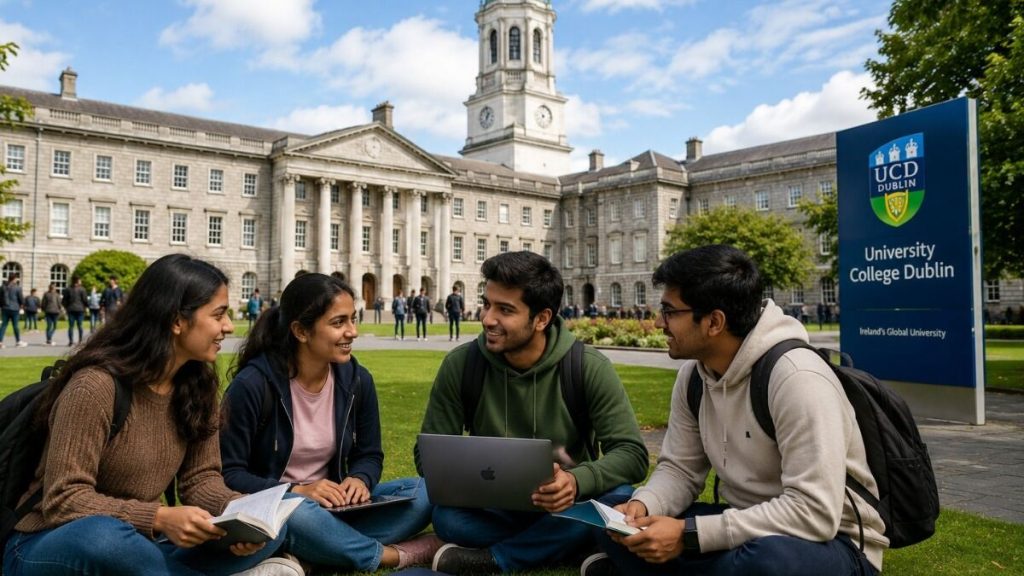
Ireland has emerged as one of Europe’s most attractive destinations for Indian students, combining tuition costs that are typically lower than the UK or the US, globally ranked universities, and one of the most generous post-study work visas in the EU.
But before you can move to Dublin, Cork, or Galway, you need to clear one essential step: securing your Ireland study visa. Whether you are headed for a master’s in data analytics or an undergraduate degree in business, understanding the right visa category, the costs involved, and the documentation required can be the difference between a smooth approval and weeks of unnecessary delay.
This guide walks you through everything related to the Ireland student visa, the types available, the fees you will pay, the requirements you must meet, and the exact application process, supported by the latest immigration data.
Why Indian Students Are Choosing Ireland
A few concrete factors explain the shift toward Ireland. It is the only English-speaking country left in the EU since Brexit, which removes the language and grading-system gap that often comes with other European destinations. It is also home to the European headquarters of several major global technology and pharmaceutical companies, which translates into real, on-the-ground job opportunities for graduates in fields like computer science, data analytics, engineering, and life sciences.
Combine that with a comparatively straightforward visa process, growing scholarship support for Indian applicants, and an already-established Indian student community in cities like Dublin and Cork, and it becomes clear why Ireland has moved from a niche choice to a mainstream one for students planning to study abroad.
According to Education in Ireland, the Irish government’s official promotional body, Indian student numbers in Ireland grew tenfold over a decade, from around 700 students in 2013 to roughly 7,000 in 2023, as reported by Careers360.
The same report notes that close to 90 percent of Indian students in Ireland are enrolled in postgraduate programs, with the remaining share pursuing undergraduate degrees, and that business, big data, science, and engineering remain the most sought-after disciplines.
Dublin, Cork, and Galway are the leading student cities, home to institutions such as Trinity College Dublin, University College Dublin, and the National College of Ireland, all of which regularly feature on Indian applicants’ shortlists when planning to study in Ireland.
Types of Ireland Study Visa
Ireland issues two categories of study visas, and choosing the correct one depends entirely on how long your course runs. The C Study Visa is meant for short courses lasting 90 days or less, such as summer schools or short professional certifications.
The D Study Visa is the long-stay visa that almost every degree-seeking Indian student needs. It applies to any full-time course longer than three months, including undergraduate, postgraduate, and PhD programs, and is the gateway to an Irish Residence Permit once you land.
| Visa Type | Key Details |
|---|---|
| C Study Visa | For courses of 90 days or less. Suitable for short-term programmes, summer schools, and professional certifications. Does not require IRP registration. |
| D Study Visa | For courses longer than 90 days. Covers Bachelor’s, Master’s, and PhD programmes. Leads to Stamp 2 IRP registration upon arrival in Ireland. |
Ireland Study Visa Requirements for Indian Students
To qualify for a D Study Visa, Indian applicants need to satisfy a fairly specific checklist set by Ireland’s Immigration Service Delivery:
- An unconditional offer letter from an institution and course listed on the Interim List of Eligible Programmes (ILEP) — visas are refused if your course is not ILEP listed
- Enrolment in a full-time course with a minimum number of weekly classroom hours
- Proof of English language proficiency, generally IELTS 6.0 to 6.5 overall with no individual band below 5.5 to 6.0, or an equivalent accepted test
- Valid private medical insurance covering the full duration of stay
- Proof of sufficient finances (detailed below)
- A clear academic record, with explanations for any gaps in education or employment
Financial Proof You’ll Need
- At least €10,000 in accessible funds for courses lasting 8 months or more
- €6,665 for an 8-month stay or €4,998 for a 6-month stay (roughly €833/month) for shorter courses
- A minimum of €6,000 already paid toward tuition fees before applying — full payment upfront if total fees are lower
Funds must sit in accessible bank accounts; fixed deposits or locked savings accounts are not accepted
These figures are confirmed on the Irish government’s official Citizens Information portal and are worth double-checking before you apply, since financial thresholds are reviewed periodically.
Ireland Study Visa Fees
Budgeting for an Ireland study visa goes beyond the application fee alone:
| Fee Type | Amount |
|---|---|
| Single-entry D Visa | €60 |
| Multiple-entry D Visa | €100 |
| IRP Registration (on arrival) | €300 |
| Private Medical Insurance | Approx. €300–€500/year |
Beyond these, also budget for document translation if needed and VFS service or courier charges. Visa fees are non-refundable even if your application is refused.
Documents Required for Your Ireland Study Visa
Before you apply, gather the following:
- Passport valid for the duration of stay, plus passport-sized photographs
- Unconditional offer or acceptance letter from an ILEP-listed institution
- Tuition fee payment receipt (minimum €6,000 paid)
- Proof of funds, bank statements or an education loan sanction letter
- Private medical insurance certificate
- English language test scorecard (IELTS/TOEFL/PTE or equivalent)
- Statement of purpose and academic transcripts/certificates
- Signed Summary Application Form generated after AVATS submission
How to Apply for an Ireland Study Visa
- Complete your application on the AVATS (Automated Visa Application and Tracking System) online portal
- Pay the visa fee and print your Summary Application Form
- Book an appointment at your nearest VFS Global centre for biometrics and document submission
- Attend your appointment and submit all required documents
- Track your application status online using your reference number
- Receive your decision; an approved visa is stamped directly into your passport
Processing Time and How to Avoid a Rejection
Most Ireland student visa applications are processed within 4 to 8 weeks, though peak intake months between June and September often see longer queues. It is advisable to apply at least 8 to 12 weeks before your course start date.
Common reasons applications get delayed or refused include incomplete or mismatched financial documents, courses that are not ILEP listed, vague or template-style statements of purpose, and inconsistencies between the offer letter and the visa application itself. Cross-checking every figure, including tuition amount, course duration, and institution name, before submission resolves most of these issues.
It also helps to keep your fund proof up to date (most banks recommend statements no older than 28 to 30 days) and to ensure your statement of purpose reflects the specific course and institution you have applied to rather than a generic template, since immigration officers routinely cross-reference SOPs against offer letters.
After You Arrive: IRP Registration and Work Rights
Once in Ireland, non-EEA students who stay longer than 90 days must register with Immigration Service Delivery to receive an Irish Residence Permit card stamped as Stamp 2. This permission allows part-time work of up to 20 hours per week during term and up to 40 hours per week during college vacations, broadly June to September and mid-December to mid-January.
What Happens After You Graduate
One of Ireland’s biggest draws for Indian students is the post-study work permission, known as Stamp 1G, which allows eligible degree graduates to stay back and work for up to 24 months. This is among the more generous post-study windows in the EU and a key reason Ireland increasingly competes with the UK and Canada for Indian applicants.
Final Thoughts
Ireland’s combination of affordable tuition, strong graduate outcomes, and a relatively predictable visa system has made it one of the fastest-growing study abroad destinations for Indian students. But the Ireland study visa process still rewards careful preparation, since accurate financial documentation, an ILEP-listed course, and a complete application are what separate a smooth approval from an avoidable delay.
If you are still working out which course, university, or visa category fits your plan, talking to an experienced Ireland education consultant can save you significant time and guesswork.
At Abroad Gateway, our team works as a dedicated Ireland study visa consultant in Chandigarh, helping students from India and abroad shortlist ILEP-listed programs, prepare compliant financial documentation, and apply for their Ireland student visa with confidence.