Canada is still one of the most popular destinations for Indians who want a long-term future abroad. Many people in Chandigarh and Mohali ask us the same question. Which Canada PR pathway is right for me?
The answer has changed in 2026. Canada Permanent Residence is still within reach. But the rules are tighter, the draws are more targeted, and fees went up in April.
This guide explains every major Canada PR option for Indians. It covers applicants in India and in Canada. You will find eligibility rules, costs, timelines, and a step-by-step process for first-time applicants.
Canada PR at a glance (2026)
- Canada plans to admit 380,000 new permanent residents each year from 2026 to 2028.
- The 2026 targets are 109,000 admissions through Express Entry and 91,500 through the Provincial Nominee Program (PNP).
- Government fees for an Express Entry principal applicant are CA$1,590 (CA$990 plus CA$600).
- A provincial nomination adds 600 CRS points, the largest single boost in the system.
- Study and work routes still lead to Canada PR. They are no longer automatic.
What Is Canada Permanent Residency?
Canada Permanent Residency lets you live, work, and study anywhere in Canada. You keep your Indian citizenship. You can use Canada’s public healthcare and sponsor eligible family members.
PR holders cannot vote in Canadian elections. After meeting the residence rules, they can apply for citizenship.
Canada PR is not one single visa. You reach it through one of many programs. That is why comparing Canada PR options matters before you start.
What Changed for Canada PR in 2026
Several updates affect Indian applicants this year. Read these before you plan your route.
- Steady PR, fewer temporary arrivals. The 2026 to 2028 plan holds PR admissions at 380,000 a year. New temporary arrivals fall to 385,000 in 2026, including 155,000 students, about half the 2025 student target.
- Higher fees. On 30 April 2026, the Express Entry principal applicant fee rose from CA$950 to CA$990. The Right of Permanent Residence Fee rose from CA$575 to CA$600.
- More category-based draws. IRCC confirmed 10 categories for 2026. Five are new, and five were renewed. Agriculture and agri-food was removed.
- Higher experience thresholds in some categories. Some analysts report that renewed categories now need 12 months of qualifying work, up from six. Always check the current criteria on the IRCC website.
- No CRS points for job offers. Points for arranged employment were removed in March 2025. They are still not part of the CRS.
- A proposed Express Entry overhaul. IRCC has proposed merging the three federal programs into one Federal High-Skilled Class. The consultation closed on 24 May 2026. At the time of the reports we reviewed, no regulation had been published.
- PGWP field list frozen. IRCC will not update the list of PGWP-eligible fields of study during 2026.
- A one-time TR to PR initiative. The In-Canada Workers Initiative aims to move up to 33,000 work permit holders to PR over 2026 and 2027.
- Some programs are closed or paused. IRCC lists the Start-up Visa and Self-employed programs as paused. The Agri-Food Pilot and the Rural and Northern Immigration Pilot are closed.
Who Can Apply for Canada PR? Applicants in India vs in Canada
Your starting point decides which Canada PR pathways are open to you. Use this table to find your match.
| Your situation | Main Canada PR options | Key point |
|---|---|---|
| Living in India with skilled work experience | Express Entry (FSW), category-based draws, some PNP streams, Quebec streams | No Canadian experience needed for FSW, but competition is high. |
| Studying in Canada | PGWP, then CEC or a PNP stream | Language and field-of-study rules apply to the PGWP. |
| Working in Canada on a PGWP or work permit | CEC, PNP, Atlantic Immigration Program, community pilots, caregiver programs | Keep your status valid while you wait. |
| Married to a Canadian citizen or PR holder | Family sponsorship | Your sponsor must meet IRCC rules. |
| Doctor, trades worker, healthcare worker, researcher, or senior manager | Category-based Express Entry draws and related programs | A category match can lower the CRS you need. |
Canada PR Pathway 1: Express Entry
Express Entry is the main route for skilled workers. It manages three programs. These are the Federal Skilled Worker Program (FSW), the Canadian Experience Class (CEC), and the Federal Skilled Trades Program (FST).
How Express Entry works
- Create a profile and enter the pool.
- IRCC invites the highest-ranked candidates in rounds.
- If invited, you submit your full application.
IRCC reviews your application and makes a decision
The three Express Entry programs
| Program | Best for | Work experience | Language | Key extra |
|---|---|---|---|---|
| FSW | Skilled workers in India or Canada | 1 year of continuous skilled work (TEER 0 to 3) in the past 10 years | CLB 7 in all four abilities | ECA for foreign education and 67 of 100 grid points |
| CEC | Workers and graduates in Canada | 1 year of skilled Canadian work in the past 3 years | CLB 7 for TEER 0 and 1. CLB 5 for TEER 2 and 3 | Experience gained with valid status |
| FST | Skilled tradespeople | 2 years in a skilled trade in the past 5 years | CLB 5 for speaking and listening. CLB 4 for reading and writing | Valid job offer or certificate of qualification |
Understanding your CRS score
Express Entry ranks profiles with the Comprehensive Ranking System (CRS). The maximum score is 1,200 points. Core factors include age, education, language, and work experience. Younger applicants generally score higher.
A provincial nomination adds 600 points. Job offers no longer add points.
Here are practical ways Indian applicants can raise a CRS score:
- Retake your language test to reach higher CLB levels.
- Add French. French-language category draws had cut-offs near 400 in early 2026.
- Get an ECA for your Indian degrees.
- Gain Canadian study or work experience.
- Explore a PNP for the 600-point boost.
Category-based draws in 2026
IRCC no longer relies only on top CRS scores. It also invites candidates in targeted categories. These include French-language proficiency, healthcare and social services, STEM, trades, and education.
New for 2026 are physicians with Canadian experience, researchers, senior managers, and skilled military recruits. The full list is on IRCC’s rounds of invitations page.
Recent results show how much the cut-off can vary:
- On 1 October 2026, a Trades draw invited 3,500 candidates with a minimum CRS of 476.
- CEC draws in 2026 had cut-offs between 507 and 523 across 17 draws, according to one analysis.
Watch this: the proposed Federal High-Skilled Class
- IRCC has proposed replacing FSW, CEC, and FST with one program.
- The proposal also covers CRS changes, including a high-wage occupation factor.
- Current programs stay active until a regulation is published.
Canada PR Pathway 2: Provincial Nominee Program (PNP)
Each province and territory can nominate people who fit its labour needs. The 2026 national PNP target is 91,500 admissions.
Two types of PNP applications
- Express Entry-aligned (enhanced) PNP. You hold an Express Entry profile. A nomination adds 600 CRS points.
- Base PNP. You apply to the province first. If nominated, you then apply to IRCC through the PR portal. Reported processing averaged about 13 months as of May 2026.
What provinces usually look for
- Skills and work experience that match local demand.
- A job offer, for many streams.
- Study or work history in that province.
- Language ability and a clear plan to settle there.
Well-known programs include Ontario’s OINP, BC PNP, Alberta’s AAIP, Saskatchewan’s SINP, and Manitoba’s MPNP. Each has its own streams and rules.
Choose a province for long-term fit, not only for speed. Your job, family, and plans should match where you settle.
Canada PR Pathway 3: The Study Route
Many Indians choose to study first and apply for PR later. The usual path has four steps.
- Study at a designated learning institution (DLI).
- Apply for a Post-Graduation Work Permit (PGWP).
- Gain skilled Canadian work experience.
- Apply through CEC or a PNP stream.
2026 rules students must know
- Language for PGWP. Degree-level graduates need CLB 7. Non-degree graduates need CLB 5.
- Field of study. Bachelor’s, master’s, and doctoral graduates are exempt from the field-of-study rule. Many diploma and certificate graduates must study an eligible field. The list is frozen for 2026.
- Test choice matters. Consultant analysis notes that IELTS Academic does not qualify as PGWP language proof. Check IRCC’s accepted test list before you book.
- Fewer study permits. The 2026 student arrival target is about half of 2025.
- Attestation letter. Consultant analysis says some master’s and PhD students are exempt from the Provincial Attestation Letter. This applies to public universities from January 2026.
A Canadian diploma is no longer a guarantee of Canada PR
• Choose your program, institution, and field with the PR plan in mind.
• Plan your language test and work experience early.
• Realistic study-to-PR journeys often take three to five years.
Canada PR Pathway 4: The Work Experience Route
Work experience is the strongest base for Canada PR. It can come from India or from Canada.
- Best if you already have skilled Canadian work experience.
- Best if your skilled work experience is from India or another country.
- Employer-linked programs. The Atlantic Immigration Program and community pilots need employer support and a job offer.
- In-Canada Workers Initiative. IRCC is speeding up PR applications from eligible work permit holders. This is a one-time measure for up to 33,000 workers.
About the In-Canada Workers Initiative
You cannot apply to this initiative directly. IRCC fast-tracks PR applications that are already submitted through certain programs. These include the PNP, the Atlantic Immigration Program, and community and caregiver pilots.
Applicants must have lived in a smaller community in Canada for at least two years. Reports say major cities are excluded.
Other Canada PR Options Worth Knowing
- Atlantic Immigration Program (AIP). Employer-driven route for workers in Atlantic Canada.
- Rural and Francophone Community Immigration Pilots (RCIP and FCIP). Community-based routes that need a job offer in the community.
- Caregiver programs. For home care workers.
- Medical doctors pathway. For physicians.
- Quebec-selected skilled workers. Quebec runs its own selection, separate from Express Entry.
- Family sponsorship. For spouses, partners, children, and other eligible relatives of Canadian citizens and PR holders.
Compare Canada PR Options at a Glance
| Pathway | Best for | Job offer needed? | Applied from | Main 2026 watch-out |
|---|---|---|---|---|
| Express Entry (FSW) | Skilled workers with foreign experience | No | India or Canada | High CRS competition |
| Express Entry (CEC) | Workers and graduates in Canada | No | Canada | Cut-offs have stayed high |
| Category-based draws | Targeted jobs and French speakers | No | India or Canada | You must match a category |
| PNP | People who fit a province’s needs | Often, by stream | India or Canada | Base PNP takes longer |
| Study route | Younger students planning ahead | No, but work is needed | Starts in India | Tighter PGWP and permit rules |
| AIP and community pilots | Workers with employer support | Yes | India or Canada | Employer and community approval |
| Family sponsorship | Spouses and partners | No | India or Canada | Sponsor must be eligible |
Not sure which Canada PR option fits you?
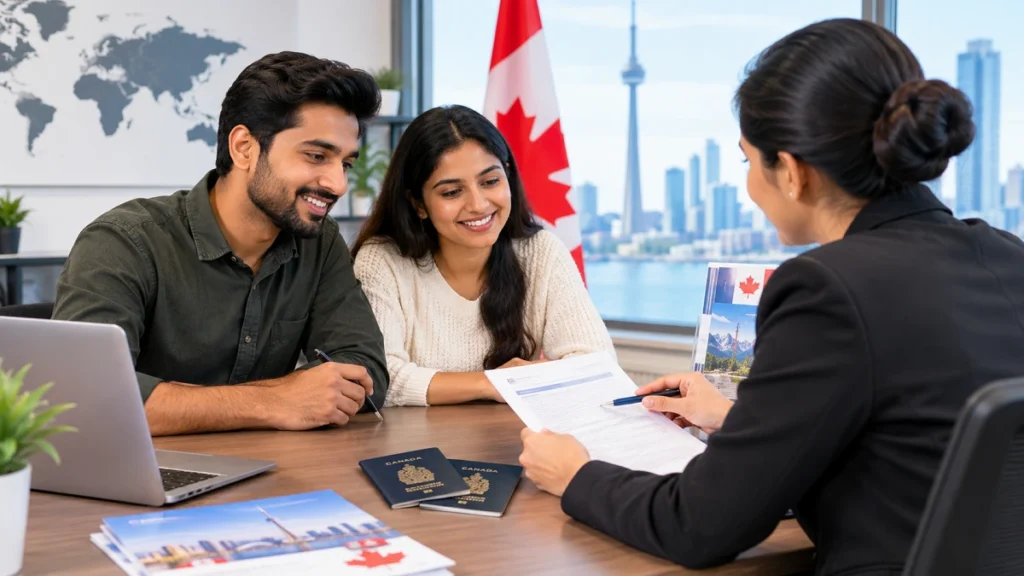
A Canada PR visa consultant can compare your options in one session. Abroad Gateway reviews your age, education, language scores, and work history. Then we show you which Canada PR pathways suit your profile.
Core Requirements for a Canada PR Application
Most Canada PR pathways ask for the same core documents. Prepare these early.
- Language test. IELTS General Training, CELPIP General, or PTE Core for English. TEF Canada or TCF Canada for French. Results must be less than two years old.
- Educational Credential Assessment (ECA). It shows that your Indian degree matches a Canadian credential. Organisations such as WES, ICAS, and IQAS issue ECAs.
- Proof of funds. A single applicant needs CA$15,263 under the table, updated on 7 July 2025. Applicants already working legally in Canada and CEC applicants are generally exempt. Check the current IRCC table.
- Police certificates. You need one from each country where you lived for six months or more since age 18. In India, you apply through Passport Seva.
- Medical exam. An IRCC-approved panel physician must complete it.
- Most applicants give fingerprints and a photo at a visa application centre.
- Work experience letters. Employer letters should list your duties, hours, pay, and dates.
Cost of Canada PR in 2026
Plan for two types of money. The first is government fees. The second is settlement funds you must show.
| Cost item | Amount (CAD) | Notes |
|---|---|---|
| Processing fee, principal applicant (Express Entry, PNP) | 990 | In force since 30 April 2026 |
| Right of Permanent Residence Fee (RPRF) | 600 per adult | Generally refunded if PR is not granted |
| Total government fees, one adult | 1,590 | Processing fee plus RPRF |
| Biometrics | 85 per person | Capped at 170 per family |
| Language test, ECA, police certificates, medical exam, translations | Varies | Depends on the provider and your documents |
| Settlement funds (single applicant) | 15,263 | Money you show in your account. It is not a fee. |
Canada PR Processing Time and Timeline
Reported averages as of May 2026 were about 7 months for Express Entry. Base PNP applications averaged about 13 months. Your time can differ. Check IRCC’s processing times tool before you plan.
| Stage | What happens | Typical time |
|---|---|---|
| Preparation | Language test, ECA, document collection | Varies by provider and country |
| Profile and pool | You create a profile and wait for an invitation | Depends on your CRS and the draws |
| Invitation to Apply (ITA) | You receive an invitation in a draw | You have 60 days to submit your application |
| IRCC processing | Medical, biometrics, background checks, decision | About 7 months for Express Entry (reported) |
| Landing | You receive your COPR and travel to Canada | Before your COPR and medical expire |
Step-by-Step Process for First-Time Applicants
If you are in India
- Check your eligibility for FSW, category draws, and PNP streams.
- Take an approved language test and aim for the highest CLB level.
- Get an ECA for your degrees.
- Find your NOC code and TEER category.
- Calculate your CRS score.
- Create your Express Entry profile. Explore PNP streams at the same time.
- Receive an ITA and submit your full application within 60 days.
- Complete medical exams, biometrics, and police certificates.
- Wait for the IRCC decision.
- Receive your COPR and plan your landing in Canada.
If you are in Canada
- Check the expiry date of your study or work permit.
- Confirm that your job fits an eligible NOC and TEER category.
- Update your language test if it is close to expiry.
- Create your Express Entry profile for CEC or a category draw.
- Apply for a PNP if your province has a stream for you.
- Submit your application after an ITA and keep your status valid.
- Wait for the decision and maintain your work authorisation.
Common Mistakes Indian Applicants Make
- Using old CRS rules that still count job offer points.
- Choosing a program that is not PGWP-eligible.
- Picking the wrong NOC code for their job duties.
- Letting a language test or ECA expire.
- Letting work or study status lapse while waiting.
- Applying to a program that is closed or paused.
- Trusting an unlicensed agent. Work with a licensed Canada PR visa consultant and check their licence on the CICC register.
Final Thoughts
Canada Permanent Residence is still possible for Indians in 2026. But the strongest applicants plan early. They match their profile to the right Canada PR pathway, and they follow the rules closely.
Rules can change fast. Check IRCC for the latest updates before you submit anything. A Canada PR visa consultation can help you stay on track.
Book Your Canada PR Visa Consultation with Abroad Gateway
Choosing between Canada PR pathways can feel confusing. Our team reviews your age, education, language scores, and work history.
We then compare your Canada PR options and help you build a clear plan. Speak to a PR visa consultant at our Chandigarh or Mohali office. Book Your Free Canada PR Visa Consultation.