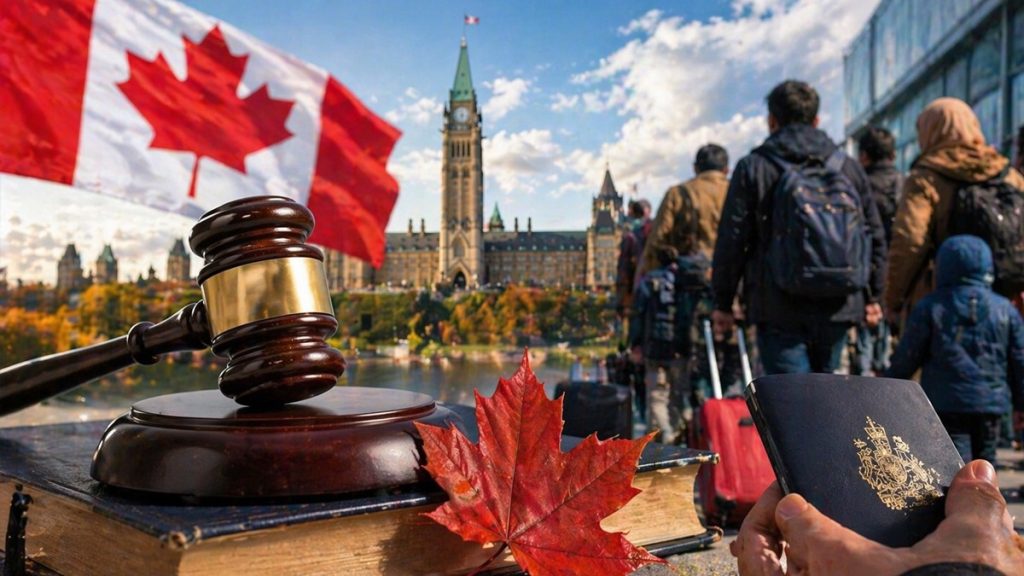
If you have been following Canada immigration news lately, you have probably heard about Bill C-12. It has been making headlines across the world and for good reason.
On March 26, 2026, Canada’s Bill C-12, officially known as the Strengthening Canada’s Immigration System and Borders Act, received Royal Assent and became law. This is one of the most significant changes to Canada’s immigration and asylum system in recent years.
But what does it actually mean for you, especially if you are an Indian student, skilled worker, or someone planning to move to Canada?
What Is Bill C-12
Bill C-12 is a new Canadian law introduced by Prime Minister Mark Carney’s government to:
- Strengthen Canada’s border security
- Reduce pressure on the asylum and refugee system
- Modernise how immigration documents and applications are managed
- Improve information sharing between government departments
The bill was first introduced in Parliament on October 8, 2025, passed the House of Commons on December 11, 2025, cleared the Senate on March 12, 2026, and finally became law on March 26, 2026.
The Government of Canada introduced Bill C-12 to strengthen border security, combat organised crime, and modernise immigration controls to keep Canadians safe. Source
It is important to understand that Bill C-12 primarily targets the asylum and refugee system, not the regular immigration pathways like Express Entry, study visas, or work permits.
Why Did Canada Introduce Bill C-12 Law
Canada has been facing increasing pressure on its immigration and asylum system for the past few years. After COVID-19, there was a massive surge in immigration applications, students, workers, and asylum seekers all at once.
The result? Long backlogs, system overload, and growing public frustration over housing shortages and rising living costs.
Immigration Minister Lena Metlege Diab told the Senate committee that 37% of asylum claims filed between June and October 2025, approximately 19,000 of 50,000 applications, are expected to be affected by the new rules. Source
Additionally, there was pressure from the United States under President Donald Trump, who accused Canada of poorly managing its shared border. Both Bill C-2 and Bill C-12 were introduced following significant pressure from US President Donald Trump, who accused Canada of failing to adequately defend the shared border and threatened tariffs. Source
The Canadian government’s response was this law: tighter rules, faster processing, and stronger border controls.
The 4 Big Changes Under Bill C-12
Bill C-12 strengthens Canada’s immigration and asylum systems in 4 key areas:
Change 1: New Asylum Eligibility Rules
This is the biggest and most controversial change in the entire bill.
Two new eligibility requirements are now in effect and apply to all claims made on or after June 3, 2025. Asylum claims made more than one year after someone’s first entry into Canada after June 24, 2020, won’t be referred to the Immigration and Refugee Board of Canada, regardless of whether the person has since left and returned. Asylum claims from people who enter Canada between ports of entry along the Canada–US land border and who make a claim after 14 days won’t be referred to the IRB either.
In simple terms:
- If you entered Canada after June 2020 and waited more than 1 year to file an asylum claim, you will NOT get a full IRB hearing
- If you crossed the Canada-US border irregularly and waited more than 14 days to file, you will NOT get a full IRB hearing
But you are not completely without protection. People who are affected by these new rules will still have access to a pre-removal risk assessment (PRRA) to prevent them from being sent back to a country where they face risks like persecution, torture or other harm.
Change 2: Modernised Asylum Process
Beyond the eligibility rules, the government is also overhauling how asylum claims are processed from start to finish.
These changes will simplify the online application process and reduce the need to answer duplicate questions and complete multiple forms, refer only complete and schedule-ready claims to the IRB to speed up decisions, ensure that the IRB decides on claims only while the claimant is physically present in Canada, remove inactive cases from the system, and speed up voluntary departures by making removal orders effective on the same day a claim is withdrawn.
The goal is a faster, leaner, and less backlogged system, one that focuses resources on genuine claims and removes cases that have been abandoned or are being used to delay removal.
Change 3: Domestic Information Sharing
This change is less dramatic but still significant for privacy-conscious applicants.
IRCC now has clear legal authority to share certain personal information within the department and with domestic government partners. These new authorities allow IRCC to share identity, status and IRCC-issued documents with federal, provincial and territorial government partners through written information-sharing agreements, and make it easier for IRCC to share client information between its own programs, for example, using permanent residence application data to process citizenship applications.
The government has confirmed that these new information-sharing powers come with built-in privacy safeguards under Canada’s Charter of Rights and Freedoms. Information can only be shared for specific, approved purposes, and provinces cannot pass it on to other countries without IRCC’s written permission.
Change 4: Immigration Document and Application Authorities
This is a significant new power given to the Canadian government that has raised eyebrows among immigration experts.
When it’s in the public interest, IRCC may cancel, suspend or change a large group of immigration documents, pause application intake, or cancel or suspend application processing. Public interest grounds include fraud, administrative errors or concerns for public health, safety or national security.
This means study permits, work permits, and visas could theoretically be cancelled in bulk during an emergency or national security situation.
However, there is an important safeguard: the decision cannot be made by a single minister; each decision requires approval by the Governor in Council through an order in council recommended by Cabinet.
Also worth noting: the authorities don’t affect asylum claims and don’t give the government power to grant, change or revoke status, such as permanent resident and temporary resident status.
What Does This Mean for Indian Students and Immigrants?
This is the question most of our readers care about. Here is the honest answer:
If you are using regular immigration pathways, you are largely unaffected.
Bill C-12 is primarily aimed at the asylum and refugee system. The following pathways remain completely intact:
- Canada Student Visa and Study Permit process — unchanged
- Express Entry and CRS points system — unchanged
- Provincial Nominee Programs (PNP) — unchanged
- Skilled Worker Visa and work permit process — unchanged
- PR after skilled work experience — unchanged
- Family sponsorship pathways — unchanged
However, you could be affected if:
- You entered Canada after June 2020 on a student or work visa, and your status has since expired, and you are now considering asylum as a backup plan
- You crossed the US-Canada border irregularly and delayed filing an asylum claim
- You are currently waiting for an IRB hearing, and entered Canada more than a year ago
If any of these situations apply to you, please consult a licensed immigration consultant immediately. Do not wait.
Key Numbers to Know
| Key Fact | Number / Detail |
|---|---|
| Date Bill C-12 became law | March 26, 2026 |
| Asylum claims affected (June–Oct 2025) | ~19,000 of 50,000 |
| Percentage of claims affected | 37% |
| Indians who got Canada PR in 2025 | 94,000+ |
| Canada’s annual PR target (2026) | 380,000 |
| Irregular entry claim window | 14 days |
| Time limit for asylum claims | 1 year from entry |
The Controversy: What Critics Are Saying
Bill C-12 has drawn strong condemnation from human rights organisations worldwide. More than two dozen organisations — including Amnesty International Canada, the Canadian Civil Liberties Association, and the Canadian Council for Refugees — warned that the law will put thousands of individuals at risk of persecution, violence and precarity.
Critics argue the 1-year rule is too harsh, unfairly blocking genuine refugees who delayed filing due to fear, trauma, or lack of legal knowledge. The United Nations Human Rights Committee also warned that Bill C-12 may weaken refugee protection, urging Canada to ensure all persons seeking international protection have access to fair and efficient procedures.
Rights groups further described the legislation as replicating US-like anti-migrant sentiment and policies in Canada.
The Canadian government, however, maintains that the law is necessary to protect the integrity of the immigration system and prevent misuse.
What Should You Do Now?
Whether you are a student planning to go to Canada, a professional on a work permit, or someone already living there, here is your action checklist:
- If you are on a valid study or work permit, stay compliant with your visa conditions. Renew on time. Bill C-12 does not affect you directly.
- If you are planning to apply for a Canadian study visa, the process is unchanged. Start your application early, prepare your documents carefully, and work with a reliable consultant.
- If you are applying for PR through Express Entry or PNP, continue your process as normal. These pathways are completely unaffected by Bill C-12.
- If your immigration status has lapsed or is about to expire, act immediately. Do not rely on asylum as a backup option. Consult a licensed immigration expert right away.
- If you entered Canada after June 2020 and have not filed an asylum claim, be aware that the 1-year eligibility rule now applies to you. Seek legal advice as soon as possible.
Worried About How Bill C-12 Affects Your Canada Plans?
Canada’s immigration rules are evolving faster than ever. One missed deadline or wrong step can put your entire application at risk. At Abroad Gateway, our expert consultants track every policy update — including Bill C-12 — so you always have the most current, accurate guidance.
We help Indian students and professionals with:
- Canada Study Visa and Student Permit Applications
- University Shortlisting and Admission Support
- Express Entry and PR Pathway Planning
- Post-Study Work Visa and Immigration Guidance
- End-to-End Support — from application to arrival
Book your FREE Canada consultation today. Don’t let changing rules confuse or delay you. Let our experts guide you — clearly, honestly, and step by step.