
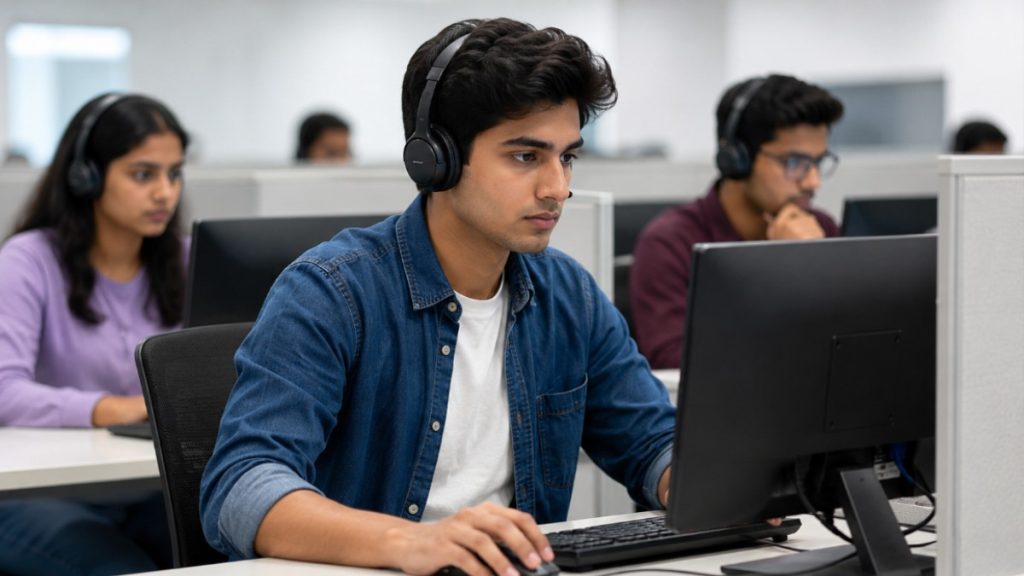
Big changes are coming to IELTS in India. IDP Education, the co-owner and official conductor of the IELTS test in India, has announced that from September 2026, the IELTS on Paper format will be completely discontinued across the country. Going forward, every IELTS candidate in India will take the test on a computer, a move IDP says is designed to make the exam faster, more flexible, and more convenient without changing what the test actually measures.
If you’re planning to apply for a study visa, PR, or work visa in 2026 or beyond, this update directly affects how you will book, prepare for, and take your English proficiency test. Here’s a complete breakdown of what’s changing, what stays the same, and how to prepare.
What Exactly Is Changing
IDP Education announced on 16 July 2026 that IELTS in India will move entirely from IELTS on Paper to IELTS on Computer. The stated goal is to give candidates greater flexibility, faster results, and a more convenient testing experience — while still delivering the same globally recognised IELTS assessment that universities, employers, and immigration authorities trust.
This isn’t a new, harder version of IELTS. It’s the same exam, delivered through a different medium.
Key Dates: When Paper-Based IELTS Exam Ends
IELTS on Paper will remain available in India only until the end of August 2026. Candidates who still want to take the paper-based test have exactly three opportunities left to register:
| Milestone | Date |
|---|---|
| Last IELTS on Paper test date #1 | 25 July 2026 |
| Last IELTS on Paper test date #2 | 6 August 2026 |
| Last IELTS on Paper test date #3 (final) | 22 August 2026 |
| IELTS on Paper discontinued in India | After 22 August 2026 |
| IELTS on Computer becomes the only format | From September 2026 |
After 22 August 2026, the paper-based version will no longer be offered anywhere in India. From September 2026 onward, IELTS on Computer will be the only way to take the test in the country.
Two IELTS Exams on Computer Options From September 2026
From September 2026, candidates in India won’t just have one computer-based format to choose from. IDP is offering two variants, so test-takers who prefer handwriting still have a route into the digital era of IELTS.
1. IELTS Exam on Computer
What it involves: Listening, Reading, and Writing are all completed on a computer. The Speaking test continues to be conducted face-to-face with a certified IELTS examiner, exactly as before.
- Type your answers directly on the screen
- Edit and revise your Writing responses easily, just like typing an email or document
- Listen to clear, high-quality audio through headphones during the Listening section
2. IELTS Exam on Computer (Writing on Paper)
What it involves: Designed for candidates who prefer writing by hand. Listening and Reading are completed on a computer, but the Writing section is still done on paper. The Speaking test remains face-to-face with a certified examiner.
This hybrid option is a good middle ground for candidates who are comfortable with digital Listening and Reading formats but aren’t yet confident typing a full Writing Task 1 and Task 2 response under timed conditions.
IELTS on Computer vs IELTS on Computer (Writing on Paper)
| Feature | IELTS on Computer | IELTS on Computer (Writing on Paper) |
|---|---|---|
| Listening & Reading | Completed on computer | Completed on computer |
| Writing | Typed on computer, with on-screen editing | Handwritten on paper |
| Speaking | Face-to-face with a certified examiner | Face-to-face with a certified examiner |
| Best suited for | Candidates comfortable typing under timed conditions | Candidates who prefer writing by hand |
| Scoring & difficulty | Same as paper-based test | Same as paper-based test |
What Stays the Same
This is the most important reassurance for anxious test-takers: the format is changing, but the exam itself is not. According to IDP Education, IELTS on Computer offers:
- The same trusted IELTS format and structure
- The same question pattern across Listening, Reading, Writing, and Speaking
- The same level of difficulty as the paper-based test
- The same scoring criteria and band descriptors
In other words, your preparation strategy, target band score, and the skills you’re being tested on remain unchanged. What changes is simply how you interact with the test.
Why IDP Is Making This Shift
The move to a fully computer-based format is aimed at making the test experience smoother and more accessible for the growing number of Indian students and professionals applying abroad every year. Key benefits IDP has highlighted include:
- Faster results — computer-delivered tests are typically processed and scored more quickly than paper-based ones
- Greater availability of test dates and slots, since computer-based centres can run more sessions
- An on-screen timer, so candidates always know exactly how much time remains
- A simpler, more intuitive interface for navigating between questions and sections
- A digital interface built specifically to support candidates through the test journey
What This Means for IELTS Aspirants
For students and professionals from Tier-2 and Tier-3 cities preparing for study-abroad or immigration applications, this shift means preparation now needs a digital dimension alongside the traditional focus on grammar, vocabulary, and fluency. A few practical implications:
- Typing speed and accuracy now matter for the Writing section under the full computer-based option
- Comfort navigating on-screen question formats (drag-and-drop, clicking to select answers, on-screen highlighting) becomes part of exam readiness
- Candidates who prefer handwriting are not left behind — the Writing on Paper hybrid option protects that choice
- Mock tests should now be taken in a computer-based environment to build familiarity with the real exam-day interface
- Booking early matters — with only three paper-based dates left (25 July, 6 August, 22 August 2026), slots are expected to fill up quickly for candidates who still want the traditional format
How to Prepare for the New IELTS Exam on Computer Format
- Practice typing your Writing Task 1 and Task 2 responses within the time limit, not just handwriting them
- Get comfortable reading longer passages on a screen for the Reading section, where eye fatigue can affect performance
- Use headphones during Listening practice to simulate the actual computer-based test environment
- Take full-length mock tests on a computer interface that mirrors the real exam, not just paper practice sets
- Continue focusing on core skills: grammar accuracy, coherence, vocabulary range, and pronunciation since the scoring criteria haven’t changed
The Bottom Line
IELTS in India is entering a new, fully digital era from September 2026. The exam pattern, difficulty level, and scoring remain exactly as they were — but candidates who adapt early to the computer-based interface, sharpen their typing skills, and choose the right format for their strengths will walk into the test centre with a clear advantage.
The shift to IELTS on Computer changes how you prepare — from typing speed to on-screen navigation. Abroad Gateway’s IELTS coaching programs in Chandigarh are updated for the new computer-based format, with mock tests on the actual digital interface, expert-led Writing and Speaking practice, and personalised score-improvement plans.