
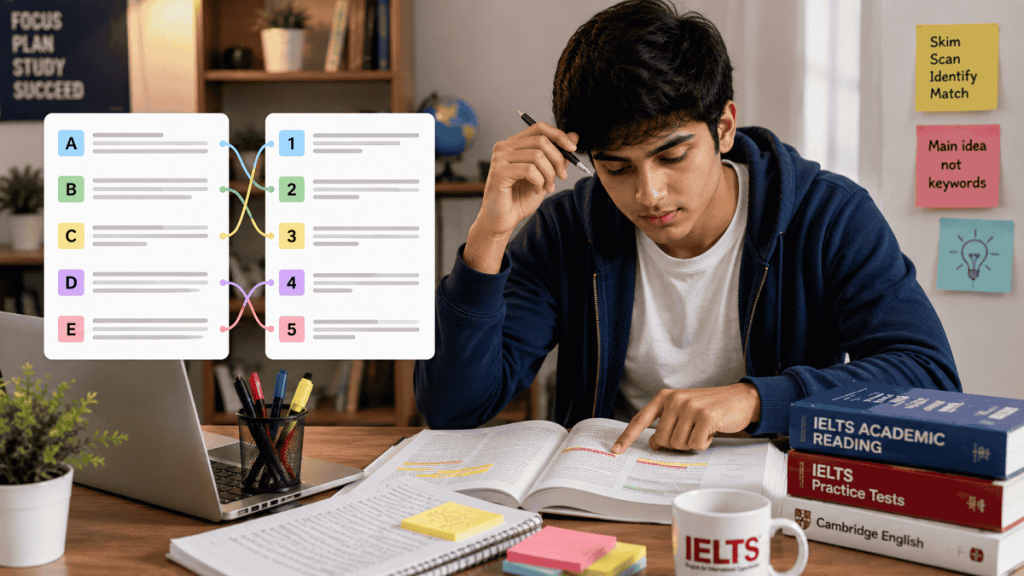
If you have ever sat down to tackle an IELTS Academic Reading paper and felt your confidence dip the moment you saw a Matching Headings question, you are not alone. Widely regarded as one of the most challenging question types in the IELTS Reading test, Matching Headings demands more than just good reading speed — it requires strategic thinking, the ability to identify a paragraph’s central idea, and the skill to distinguish subtle differences between similar-sounding options.
Whether you are targeting a Band 6.5 for a Canadian PR pathway or a Band 7+ for admission to a German university, mastering this section can make a measurable difference to your overall score.
This guide breaks down exactly what Matching Headings involves, walks you through a proven strategy, and equips you with expert tips to avoid the common traps that cost test-takers valuable marks.
What Are IELTS Reading Matching Headings?
Matching Headings is a core question type in the IELTS Academic Reading test. In this task, you are given a list of headings, each representing a possible title for a paragraph, and your job is to select the heading that best captures the main idea of each numbered paragraph in the passage.
Key features of this question type:
- There are always more headings than paragraphs, typically two or three extra options to make the task more challenging.
- Not all paragraphs will have a heading to match; some may be excluded.
- The task tests your ability to identify the central idea (not specific details) of each paragraph.
- Synonyms and paraphrases are frequently used in headings, so a direct keyword match is rarely the correct approach.
In this type of question, the test taker has to match the relevant heading with the correct paragraph of the reading text. Having more titles than paragraphs in the text makes it more intricate and takes comparatively more time to solve than other questions. Therefore, this type of question tests one’s ability to identify the central idea and recognise its supporting details.
5-Step Strategy to Tackle Matching Headings
Step 1: Read All the Headings First
Before you touch the passage, read through the entire list of headings carefully. Do not skim; give each heading your full attention. The goal here is to build a mental map of the themes and topics you are about to encounter. When you subsequently read each paragraph, you will already have a framework to work with rather than approaching the text blindly.
Pro tip: Note any headings that seem very similar to each other; these are deliberate distractors. Being aware of them early prevents last-minute confusion.
Step 2: Identify and Underline Keywords in Each Heading
For every heading, underline or mentally note the keywords; these are typically nouns, proper nouns, dates, or specific concepts. Keywords are your anchors when you scan the passage. However, a critical point to remember is that the passage will rarely use the same words. IELTS examiners deliberately paraphrase headings, so look for the meaning behind the keywords, not the words themselves.
Example: A heading that reads “The economic impact of deforestation” might correspond to a paragraph that uses phrases like “financial consequences of forest clearance”; same idea, entirely different words.
Step 3: Identify Similarities and Differences Between Headings
This is the step most test-takers skip, and it is often the one that separates high scorers from the rest. Before reading the passage, spend sixty seconds comparing the headings against each other. Group similar headings together and note the precise difference between them.
This exercise sharpens your focus when you read the paragraphs, making it easier to select the most accurate match rather than settling for one that is merely close.
Step 4: Read the First and Last Sentences of Each Paragraph
Academic writing is structured. The first sentence of a paragraph typically introduces its main idea (the topic sentence), and the final sentence often summarises or reinforces it. Use this structure to your advantage: read the first and last sentences of a paragraph, form a hypothesis about its heading, then skim the middle sentences to confirm.
This targeted reading approach saves significant time compared to reading every word of every paragraph.
Important: Do not ignore the middle sentences entirely. If the first and last sentences lead to two plausible headings, a quick scan of the body sentences will resolve the ambiguity.
Step 5: Choose the Heading That Captures the Whole Paragraph
This is the most important rule in Matching Headings: a heading must reflect the main idea of the entire paragraph, not just one detail mentioned within it. A common mistake is selecting a heading that matches a specific sentence or example in the paragraph, but if that detail is not the central theme, it is a trap. The correct heading will summarise what the whole paragraph is about.
Once you are confident in a match, mark it and move on. If you are unsure, leave it and return after completing the others — sometimes the remaining options make the answer clearer.
Quick Reference: 5-Step Strategy at a Glance
| Step | Action | Why It Matters |
|---|---|---|
| 1 | Read all headings | Builds a mental map before tackling the passage. |
| 2 | Underline keywords | Helps locate relevant content without reading word-for-word. |
| 3 | Compare headings | Reveals deliberate distractors early. |
| 4 | First + Last Sentences | Efficiently identifies the paragraph’s central theme. |
| 5 | Match the Whole Idea | Avoids detail traps — the heading must cover the entire paragraph, not just one detail. |
Expert Tips for Matching Headings
Apply these tips alongside the five-step strategy to further improve your accuracy and speed:
- Watch out for synonyms and paraphrases: IELTS examiners deliberately avoid repeating the exact words from the passage in the headings. Train yourself to recognise meaning, not just matching vocabulary. If a heading uses the word “decline,” the passage might say “reduction,””fall,” or “decrease.”
- Skim for general understanding — but do not rush: A quick skim of the passage before working question-by-question gives you a general sense of the text’s structure. However, skimming too fast means missing the nuance that distinguishes correct headings from close distractors.
- Never choose a heading based on a single detail: If a paragraph mentions several points and one of them directly matches a heading, resist the temptation. The correct heading must represent the dominant idea of the entire paragraph.
- Ignore prior knowledge about the topic: Your own knowledge about the subject can be misleading. Base your answers entirely on what the passage says, not what you already know or expect to be true.
- Stuck on one paragraph? Move on and return: If you cannot confidently match a paragraph, skip it temporarily. As you complete other matches, the remaining headings narrow down, and the answer often becomes clearer.
- Use elimination effectively: Once you are confident about a heading, cross it out from your options list. Narrowing your choices makes subsequent matches faster and reduces decision fatigue.
Common Mistakes to Avoid
| Common Mistake | What to Do Instead |
|---|---|
| Matching headings based on a single keyword | Look for the paragraph’s overall theme, not just one matching word. |
| Reading the entire passage word-for-word | Use targeted reading: read the first and last sentences, then skim the middle for supporting ideas. |
| Selecting a heading that covers only part of the paragraph | Choose a heading that represents the entire paragraph’s main idea, not just one section. |
| Spending too long on one difficult paragraph | Skip it temporarily and return later; other answers may help eliminate options. |
| Using personal knowledge rather than the text | Base every answer strictly on what the passage states, not on outside knowledge or assumptions. |
Conclusion
Matching Headings is challenging by design, but it is also one of the most learnable question types in the IELTS Reading test. The key to improvement is deliberate practice. Work through past IELTS papers, apply these steps consciously, and review every incorrect answer to understand why it was wrong. Over time, you will develop an instinct for identifying main ideas quickly and accurately, a skill that improves your Reading score across every question type, not just Matching Headings.
Ready to Crack IELTS? Get Expert Coaching at Abroad Gateway
At Abroad Gateway, our expert IELTS coaching institute in Chandigarh helps you master every section of the test — Listening, Reading, Writing, and Speaking — using proven strategies tailored to your target band score.
- Personalised study plans
- Mock tests with expert feedback
- Band 6.5+ guarantee programmes