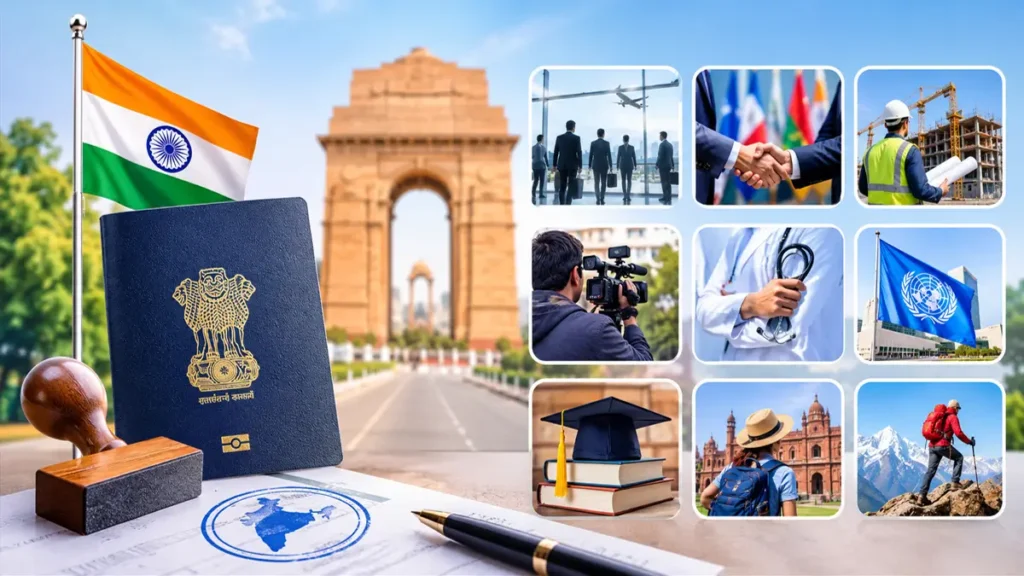
On 11 November 2026, the Ministry of Home Affairs (MHA) announced a major overhaul of India’s visa system. The number of main visa categories falls from 13 to 9, sub-categories drop from 49 to 23, and the number of fields on application forms is cut by 65 to 70 per cent. The old Tourist Visa has also been renamed the Visitor Visa.
One thing to know before you read further: the new framework is not live yet. The MHA is updating its IT systems and expects to start issuing visas under the new structure by the end of 2026. Until then, applicants should continue to use the current system.
In this guide, we break down what has changed, who it affects, and how to prepare, in plain language.
India’s Visa Reform at a Glance
| What changed | Details |
|---|---|
| Main visa categories | Reduced from 13 to 9 |
| Sub-categories | Reduced from 49 to 23 |
| Application form fields | Reduced by 65 to 70 per cent across all 23 sub-categories |
| Tourist Visa | Renamed Visitor Visa (V-1 and V-2) |
| E-visa availability | Available to nationals of 172 countries |
| Expected rollout | By the end of 2026 |
This is the second round of simplification. In October 2025, the government had already reduced the main categories from 22 to 13 and the sub-categories from 63 to 49. The MHA says the latest reduction was made on 27 August 2026, and it was formally announced in November.
Why Did India Simplify Its Visa System?
The MHA described the goal as making the visa regime “more compact, coherent and responsive” to the needs of foreign nationals visiting India. In practical terms, the government wants to remove overlapping categories so that a traveller can quickly work out which visa fits their purpose.
The ministry also said it studied the visa systems of developed countries and global standards before finalising the changes. The reforms are aimed at boosting tourism, medical travel, foreign student arrivals and business engagement, and they link to the government’s “Heal in India” vision for medical value travel.
The travel industry has welcomed the move, though some trade voices say simplification alone will not be enough without stronger overseas promotion of India as a destination.
The 9 Main Visa Categories Under the New Framework
| No. | Category | Who it is for |
|---|---|---|
| 1 | Business Visa | Foreigners setting up ventures, attending conferences, taking part in sports or cultural events, or working on film shoots |
| 2 | Diplomatic Visa | Diplomats, including UN diplomats, and their dependents |
| 3 | Work Visa | People working long-term with Indian companies or NGOs, and missionary work |
| 4 | Journalist Visa | Accredited journalists in India |
| 5 | Medical Visa | Patients seeking treatment, including AYUSH, and their attendants |
| 6 | Official Visa | Non-diplomatic officials, including UN officials, and their dependents |
| 7 | Student Visa | School, graduate and postgraduate study, research, internships and exchange programmes |
| 8 | Visitor Visa | Short and long visits, including business meetings, medical consultations, wellness retreats and mountaineering |
| 9 | Miscellaneous Visa | Persons of Indian origin and their families, Auroville joiners and other special cases |
The Tourist Visa Is Now the Visitor Visa
The biggest change for most travellers is the renaming of the Tourist Visa as the Visitor Visa. The new name reflects a wider list of permitted activities beyond conventional sightseeing. The category has two sub-categories.
V-1 Visa: Short Visits
The V-1 is granted for 30 days with multiple entries. It covers short-term activities such as:
- Business meetings
- Medical consultations
- Wellness retreats
- Short-duration medical treatment
- Short courses in Indian languages, music, art and craft
V-2 Visa: Longer Stays
The V-2 is meant for longer-duration visits, with validity of one, five or 10 years, as specified. It covers everything allowed under V-1 and also includes mountaineering. Visitors travelling for mountaineering will receive a six-month multiple-entry visa.
Why This Matters
Under the old system, a traveller who wanted to combine a holiday with a business meeting or a wellness programme could be unsure which visa to pick. Bringing these short-term purposes under one clearly defined category is intended to cut that confusion and make visa selection simpler.
Medical Visa Changes: M-1 to M-4
The medical visa framework keeps separate tracks for conventional treatment and AYUSH therapies.
- M-1: medical treatment other than AYUSH systems
- M-2: attendants accompanying an M-1 holder
- M-3: treatment under AYUSH systems
- M-4: attendants accompanying an M-3 holder
M-1 and M-3 visas, including their e-visa versions, will ordinarily be granted for one year with multiple entries. For patients who need follow-up consultations or staged procedures, this means they do not have to reapply for every visit.
Student Visa Changes: S-1 and S-2
Student visas are now consolidated into two sub-categories.
- S-1: school, graduate and postgraduate education
- S-2: PhD scholars and research students, visiting faculty, internships, student exchanges, and scientific and anthropological expeditions
Foreign students enrolled in Indian institutions through the Study in India portal may be eligible for an e-S1 visa valid for up to five years or the duration of their course, whichever is shorter, with multiple entries. Linking the visa to the length of the course reduces repeated paperwork for students.
Business Visa Changes: B-1 and B-2
The Business Visa is now split into two lanes based on how long the activity lasts.
- B-1: long-term, licence-based business activities, including foreign nationals setting up industrial or business ventures in India
- B-2: short-term, contract-based activities such as conferences, sports, performing arts, films and production investment
Production Investment Business Visa
Foreign engineers, subject-matter specialists and technical personnel hired by Indian companies can now apply for a Production Investment Business Visa under B-2 through the e-visa platform. This covers assignments such as installation and commissioning, maintenance, training, IT and ERP ramp-up, and transfer of technology and know-how. It replaces the earlier e-B4 label.
What About the Miscellaneous Visa?
The Miscellaneous category is a catch-all for cases that do not fit elsewhere. According to the MHA, it covers:
- Persons of Indian origin and their spouses and children
- People joining specified institutions such as the Auroville Foundation
- Dependents of foreign nationals on long-duration visas
- Long-term visas for certain categories of nationals from neighbouring countries
- Other purposes not covered by any other visa category
All Named Sub-Categories Under the New Framework
Public reporting names 10 of the 23 new sub-categories so far, and they cover the Visitor, Medical, Student and Business categories.
| Sub-category | Main category | Who it is for |
|---|---|---|
| V-1 | Visitor | Short-term visitors on 30-day multiple-entry visits for business meetings, medical consultations, wellness retreats, short treatment, or short courses in Indian languages, music, art and craft |
| V-2 | Visitor | Visitors who need a longer stay of one, five or 10 years, and mountaineering visitors (six-month multiple-entry visa) |
| M-1 | Medical | Patients seeking medical treatment outside AYUSH systems |
| M-2 | Medical | Attendants accompanying an M-1 patient |
| M-3 | Medical | Patients seeking treatment under AYUSH systems |
| M-4 | Medical | Attendants accompanying an M-3 patient |
| S-1 | Student | Students in school, graduate and postgraduate education, including Study in India portal students who may get an e-S1 of up to five years or the course length |
| S-2 | Student | PhD and research scholars, visiting faculty, foreign research students, interns, exchange students, and members of scientific or anthropological expeditions |
| B-1 | Business | Foreigners doing long-term, licence-based business, including setting up industrial or business ventures in India |
| B-2 | Business | People on short-term, contract-based work such as conferences, sports, performing arts, films and production investment, including foreign engineers and specialists hired by Indian companies (Production Investment Business Visa, which replaces e-B4) |
Application Forms Are 65 to 70 Per Cent Lighter
Alongside the category changes, the MHA has reduced the required fields and columns in application forms for all 23 sub-categories by 65 to 70 per cent. The ministry says the essential details needed for processing have been retained.
For applicants, that should mean less time spent filling in forms. For officials, the ministry says it allows more focused scrutiny of each application.
When Will the New Rules Take Effect?
The MHA is updating its IT systems to support the new structure and says visas will be granted under the revised framework by the end of 2026. Business Today reported that the necessary IT upgrades are in their final stages.
Some trade bodies have said the government agreed in consultations to extend the advance-application window for the e-Visitor Visa and to bring certain area permits into the e-visa system. These points have not appeared in the official MHA statement, so treat them as pending until a final notification is issued.
What This Means for Indians With Foreign Family, Partners or Business Contacts
These rules apply to foreign nationals coming into India. They do not change anything for Indian citizens applying for visas to other countries. But if you have overseas relatives, a foreign spouse or international business partners, the changes may affect how you invite them.
- Foreign spouse or children of Indian origin: the Miscellaneous category is the one to look at.
- Overseas business partners visiting India: check whether their plans fit B-1 (long-term, setting up operations) or B-2 (short-term, contract-based work).
- Relatives or friends visiting for a short stay or a cultural course: the V-1 Visitor Visa is likely the closest fit.
Always confirm eligibility and documents on the official Indian visa portal, because the exact requirements for each sub-category will only be clear once the new system goes live.
How to Prepare: A Quick Checklist
- Identify the purpose of travel first, then match it to a category.
- Check whether the traveller’s nationality is among the 172 countries eligible for the e-visa.
- Keep the passport, photograph and supporting documents ready.
- Watch the official MHA and e-visa portals for the go-live announcement.
- Be careful with third-party websites claiming the new system is already open.
Frequently Asked Questions
Has India discontinued the Tourist Visa?
The Tourist Visa has been renamed the Visitor Visa. It now covers a wider range of activities beyond conventional tourism, and it is divided into V-1 and V-2.
How many visa categories does India have now?
India has 9 main visa categories and 23 sub-categories under the revised framework, down from 13 and 49.
What is the difference between V-1 and V-2?
V-1 is valid for 30 days with multiple entries and covers short-term activities. V-2 is valid for one, five or 10 years and also covers mountaineering.
When will the new visa rules start?
The MHA expects to issue visas under the new framework by the end of 2026, once its IT systems are updated.
Do these changes apply to Indian citizens?
No. The changes apply to foreign nationals visiting India. Indian citizens applying for visas to other countries follow the rules of those countries.
Is the e-visa still available?
Yes. The e-visa facility is currently available to nationals of 172 countries.
Final Thoughts
India’s visa reform is a clear step towards a simpler, purpose-based system: fewer categories, clearer activity lists and much shorter forms. The real test will be how smoothly the new system works once it launches at the end of the year.
Visa rules look different depending on where your journey begins. At Abroad Gateway, we help both international visitors coming to India and Indians heading abroad to choose the right visa category and prepare their documents with confidence.
Disclaimer: Visa rules can change, and this article is for general information only. Please confirm all details on the official government portals before applying.