
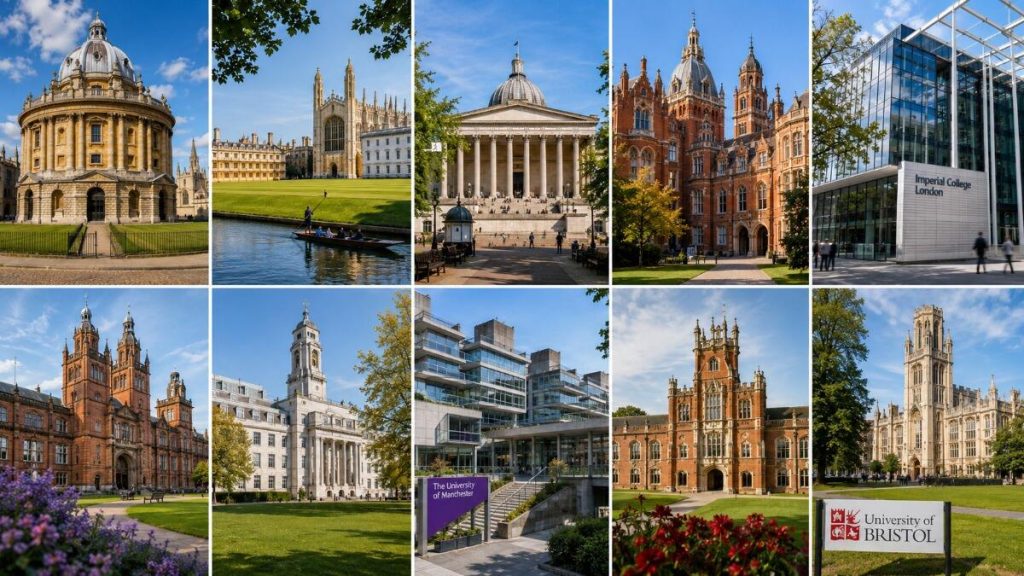
The United Kingdom continues to be one of the most sought-after destinations for postgraduate education. With 90 universities in the UK featured in the QS World University Rankings 2026 and 17 of them in the global top 100, the country offers a world-class academic environment across virtually every field of study.
For Indian students, the appeal of Master’s degrees in UK goes beyond prestige: most programmes are just one year long, which means lower total costs and a faster return to the workforce compared to two-year programmes in the USA or Australia.
Whether you are drawn to technology, finance, law, data science, or the humanities, courses in UK universities cover every discipline imaginable. This guide ranks the top 10 universities, highlights key Master’s programmes, compares fees in GBP and INR, and shares what Indian students need to know before they apply.
Why Choose Universities in the UK for a Master’s Degree?
Studying at universities in the UK offers several advantages that make it a strong choice for Indian students in 2026–27:
- One-year taught Master’s programmes save both time and money
- Globally recognised degrees respected by employers in 190+ countries
- Strong graduate employability: around 78% of international Master’s graduates secure employment or further study within 6 months of graduating (UKCISA)
- Graduate Route visa: post-study work rights of 18 months after completing a Master’s (for 2026–27 starters)
- Diverse campus culture with students from 150+ countries
Top-Ranked UK Universities for Master’s Degrees in 2026–27
1. University of Oxford — QS 2026 Global Rank: #4 | THE 2026: #1
Founded in the 12th century, the University of Oxford is one of the oldest and most prestigious universities in the world. Oxford is the top-ranked university in the world according to the Times Higher Education Rankings 2026, and sits at #4 globally in QS. It leads the QS 2026 subject rankings in four disciplines — Anatomy & Physiology, Anthropology, Geography, and Modern Languages — and ranks #1 globally in Arts & Humanities.
The study in UK experience at Oxford is defined by its rigorous tutorial system, access to over 100 libraries, and an alumni network that spans governments, research centres, and global corporations.
- Popular courses: MBA (Saïd Business School), MSc Data Science, LLM, MSc Global Governance & Diplomacy, MPhil Modern Languages
- International fees (2026–27): £37,380–£62,820 per year
- IELTS: 7.0+ | Bachelor’s requirement: 70%+ for Indian students
2. Imperial College London — QS 2026 Global Rank: #2
Imperial ranks #2 in the world in QS 2026 — the highest of any university in the UK. A specialist STEM institution based in central London, Imperial attracts over 9,000 international postgraduates each year and has deep ties with industries including AI, healthcare, and engineering. Its research impact in technology and medicine is consistently ranked among the world’s best.
- Popular courses: MSc Computing (AI), MSc Biomedical Engineering, MSc Finance, MSc Environmental Technology
- International fees: £26,000–£38,000 per year (approx. ₹34L–₹49L)
- IELTS: 6.5–7.0 | Bachelor’s requirement: 70%+
3. University of Cambridge — QS 2026 Global Rank: #5
Cambridge is one of the most prestigious universities in the UK for postgraduate study, with over 11,000 Master’s and PhD students enrolled at any given time. The university excels in Engineering, Natural Sciences, Economics, and Computer Science, and many courses are linked directly with leading research labs and global employers. The Gates Cambridge Scholarship offers fully funded opportunities for outstanding international students.
- Popular courses: MPhil Engineering, MPhil Economics, Master of Finance (MFin), MPhil Computer Science
- International fees (2026–27): £29,052–£70,554 + annual college fee of £11,500–£14,950
- IELTS: 7.0+ | Bachelor’s requirement: 70%+
4. University College London (UCL) — QS 2026 Global Rank: #9
UCL offers one of the broadest selections of courses in UK universities, with 600+ Master’s programmes covering Architecture, Data Science, Global Health, Education, and more. Its student body includes learners from 150+ countries, making it one of the most internationally diverse universities in the UK. For Indian students with 65–70% in their bachelor’s degree, UCL is a realistic and highly reputed option.
- Popular courses: MSc Data Science, MSc Global Health, MArch, MSc Finance, MA Education
- International fees: £18,000–£30,000 per year (approx. ₹23L–₹39L)
- IELTS: 6.5–7.0 | Bachelor’s requirement: 65–70%
5. London School of Economics (LSE) — QS 2026 Rank: #56 | National Rank: #3
LSE’s global QS rank of 56 understates its real-world influence. The school has produced 18 Nobel laureates, 37 past or current world leaders, and alumni who run central banks and shape international policy. For students interested in Finance, Economics, Public Policy, or International Relations, no other university in the UK comes close to LSE’s domain authority.
- Popular courses: MSc Finance, MSc International Relations, MSc Public Policy, MSc Economics
- International fees (2026–27): £24,000–£33,000 per year (approx. ₹31L–₹43L)
- IELTS: 7.0 | Bachelor’s requirement: 65–70%
6. University of Edinburgh — QS 2026 Global Rank: ~#27
The University of Edinburgh is one of the most accessible top-ranked universities in the UK for Indian applicants with 65–70% in their bachelor’s degree. It excels in AI, Law, Business, and Climate Science. Edinburgh consistently outperforms its QS rank in THE’s research influence indicators, making it especially strong for research-led Master’s programmes.
- Popular courses: MSc Artificial Intelligence, MSc Finance, LLM, MSc Global Environment & Climate Change
- International fees: £23,000–£32,000 per year (approx. ₹30L–₹41L)
- IELTS: 6.5 | Bachelor’s requirement: 65%+
7. University of Manchester — QS 2026 Global Rank: #35
Manchester is one of the most popular choices for Indian students pursuing Master Degrees in UK, and for good reason. A large, research-intensive university with strong employer links, Manchester accepts standard 3-year Indian bachelor’s degrees and offers more realistic entry thresholds than Oxbridge. Its MSc Data Science and MBA programmes are particularly well regarded.
- Popular courses: MSc Data Science, MBA, MSc Advanced Computer Science, MSc International Business
- International fees: £22,000–£30,000 per year (approx. ₹28L–₹39L)
- IELTS: 6.5 | Bachelor’s requirement: 55–60%
8. King’s College London (KCL) — QS 2026 Global Rank: #31
King’s College London combines a central London location with strong academic depth in Law, Medicine, Humanities, and War Studies. Its LLM is ranked among the best in the world, and its partnerships with NHS trusts and international organisations make it a top choice for health and policy-focused Master’s programmes.
- Popular courses: LLM, MA International Relations, MSc Neuroscience, MSc Global Health
- International fees: £22,000–£32,000 per year (approx. ₹28L–₹41L)
- IELTS: 7.0 | Bachelor’s requirement: 65–70%
9. University of Warwick — QS 2026 Global Rank: ~#67
Warwick Business School is consistently ranked among Europe’s best, and Warwick’s Economics and Mathematics departments are world-class. It is a particularly strong choice for students targeting Finance, Business Analytics, and Quantitative Economics — areas where its placement record rivals much higher-ranked institutions.
- Popular courses: MSc Finance, MBA, MSc Economics, MSc Business Analytics
- International fees: £24,000–£32,000 per year (approx. ₹31L–₹41L)
- IELTS: 6.5 | Bachelor’s requirement: 60–65%
10. University of Bristol — QS 2026 Global Rank: ~#55
Bristol is a research-intensive Russell Group university with strengths in Engineering, Computer Science, Law, and Economics. It offers a strong academic environment at a relatively lower cost of living compared to London, making it a cost-effective option for students planning to study in UK without compromising on quality or employer recognition.
- Popular courses: MSc Computer Science, MSc Economics, LLM, MSc Robotics
- International fees: £20,000–£28,000 per year (approx. ₹26L–₹36L)
- IELTS: 6.5 | Bachelor’s requirement: 55–60%
Quick Comparison: Top 10 UK Universities at a Glance
| University | QS 2026 Rank | Int’l Fees (£/yr) | Fees (INR approx.) | Best For |
|---|---|---|---|---|
| Oxford | #4 | £37,380–£62,820 | ₹48L–₹81L | Law, MBA, Humanities |
| Imperial College London | #2 | £26,000–£38,000 | ₹34L–₹49L | STEM, AI, Engineering |
| Cambridge | #5 | £29,052–£70,554+ | ₹38L–₹91L | Science, Economics, CS |
| UCL | #9 | £18,000–£30,000 | ₹23L–₹39L | Data Science, Architecture |
| LSE | #56* | £24,000–£33,000 | ₹31L–₹43L | Finance, Policy, IR |
| University of Edinburgh | ~#27 | £23,000–£32,000 | ₹30L–₹41L | AI, Business, Law |
| University of Manchester | #35 | £22,000–£30,000 | ₹28L–₹39L | Data Science, MBA, CS |
| King’s College London | #31 | £22,000–£32,000 | ₹28L–₹41L | Law, Medicine, IR |
| University of Warwick | ~#67 | £24,000–£32,000 | ₹31L–₹41L | Business, Finance, Economics |
| University of Bristol | ~#55 | £20,000–£28,000 | ₹26L–₹36L | Engineering, Law, CS |
*INR conversion at approx. £1 = ₹129–130. Verify current rates before financial planning. LSE’s domestic national rank is #3 despite QS global rank of #56.
Key Things Indian Students Must Know Before Applying
Before you apply for a UK study visa, keep these practical points in mind:
- Eligibility: Most universities accept a 3-year Indian bachelor’s degree. Mid-tier universities require 55–60%; UCL and KCL need 65–70%; Oxford, Cambridge, and Imperial expect 70%+
- IELTS: A score of 6.5 overall (no band below 6.0) covers most universities. Competitive programmes at UCL, Imperial, and Oxford often require 7.0+. PTE Academic and TOEFL are also accepted.
- Tuition deposit: Most universities require a deposit of £1,000–£5,000 before issuing your CAS (Confirmation of Acceptance for Studies). Factor this into your education loan timeline.
- Maintenance funds: You must show 28 days of bank statements before submitting your UK study visa application. The total liquid amount required can reach ₹8–12 lakh; plan ahead.
- Scholarships: GREAT Scholarship (£10,000 toward tuition, no work experience required), Chevening (next cycle opens ~August 2026 for 2027–28 entry), Gates Cambridge, Rhodes, and university-specific bursaries are available.
- Graduate Route visa: 2026–27 starters will receive 18 months of post-study work rights. No job offer is needed to apply — but start your job search from Semester 1, not after graduation.
How to Apply for a UK Study Visa
After receiving an offer from a UK university, international students must apply for a UK Student Visa. The application process generally requires:
- Confirmation of Acceptance for Studies (CAS)
- Valid passport
- Proof of funds
- English language test results
- Tuberculosis test certificate (if applicable)
Applying correctly is essential to avoid delays or refusals.
Need Help Studying in the UK?
Choosing the right university, preparing application documents, and securing a UK study visa can be challenging. Abroad Gateway provides expert guidance on university admissions, course selection, scholarship opportunities, and visa applications.
Our experienced study visa counsellors can help you identify the best university based on your academic background, career goals, and budget, making your journey to study in the UK smooth and successful.