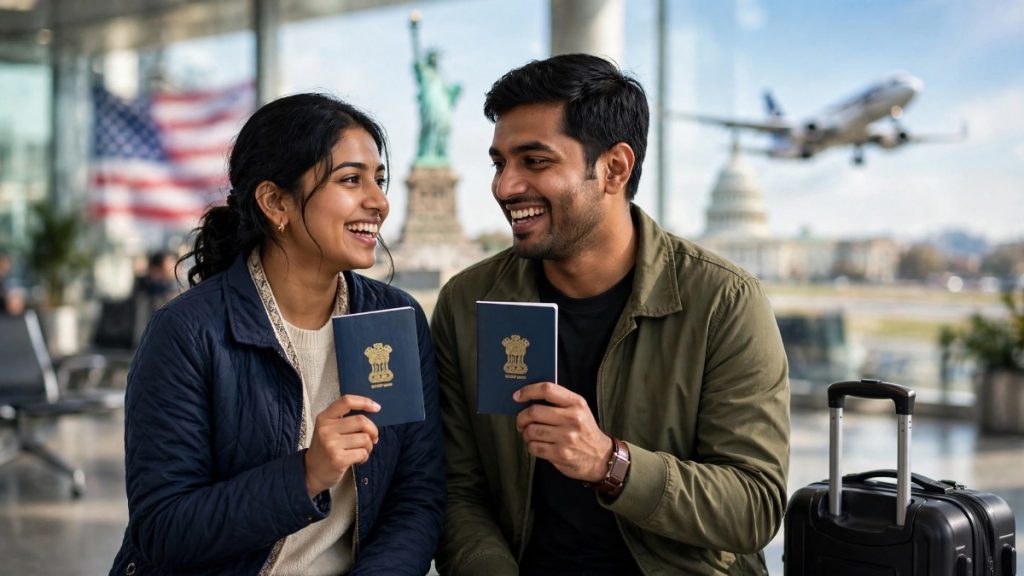
If you’re planning a trip to the United States to visit family, attend a business meeting, explore the country as a tourist, or get medical treatment, the B1/B2 visa is almost certainly the visa you need. It is the most commonly issued US visa category for Indian travellers, and also one of the most misunderstood — applicants often confuse it with a work visa, underestimate the documentation needed, or get caught off guard by long appointment wait times.
This guide walks you through everything: what the B1/B2 visa actually covers, who qualifies, what it costs in 2026, how long the process takes, which documents you’ll need, and how to prepare for the interview so your application has the best possible chance of approval.
1. What Is a US Visitor Visa (B1/B2)?
The B1/B2 is a US nonimmigrant visitor visa that allows temporary travel to the United States. It is technically two visa categories rolled into one:
- B-1 (Business Visitor): For temporary business activities such as attending conferences, negotiating contracts, consulting with business associates, or settling an estate. It does not permit employment or receiving a salary from a US company.
- B-2 (Visitor for Pleasure): For tourism, visiting family and friends, medical treatment, and participating in social or fraternal events such as weddings.
Most Indian applicants are issued a combined B1/B2 visa, which gives the flexibility to travel for either purpose on the same visa without having to specify one or the other in advance.
What a B1/B2 Visa Does NOT Allow
- Working for a US employer or accepting payment from a US-based source
- Enrolling in a full-time academic degree program
- Living permanently in the United States
- Guaranteed entry — the visa lets you request entry; a CBP officer at the port of entry makes the final call
2. US Visitor Visa (B1/B2): Key Differences
| Aspect | B-1 (Business) | B-2 (Tourism/Visit) |
|---|---|---|
| Purpose | Business meetings, conferences, contract negotiation, consulting | Tourism, visiting family/friends, medical treatment, social events |
| Employment | Not permitted — no salary from a US source | Not permitted |
| Typical activities | Attending trade shows, meetings with clients, arbitration | Sightseeing, weddings, short medical procedures |
| Issued as | Usually combined with B-2 | Usually combined with B-1 |
| Stay per visit | Determined by CBP officer at entry, typically up to 6 months | Determined by CBP officer at entry, typically up to 6 months |
3. US Visitor Visa (B1/B2) Eligibility Criteria
Every B1/B2 application is evaluated under Section 214(b) of the US Immigration and Nationality Act, which starts from the legal presumption that every applicant intends to immigrate. The burden is on you to demonstrate otherwise. In practice, this means a consular officer is checking whether your overall profile supports a temporary visit — not permanent relocation.
To qualify, you generally need to show:
- A clear, specific purpose for the visit (tourism, a business meeting, a family event, medical treatment)
- Sufficient funds to cover the trip without needing to work illegally in the US
- Strong ties to India — such as a job, business, property, or family — that make it clear you intend to return
- A passport valid for at least six months beyond your intended stay
- No prior visa violations, overstays, or grounds of inadmissibility under US immigration law
There is no minimum income, employment type, or education level required by law — but weaker documentation of ties to India (for example, unstable employment, no immovable assets, or a first-time passport with no travel history) generally invites more scrutiny.
Important: Letters of Invitation Are Not Required
- The US State Department is explicit on this point: a letter of invitation or Affidavit of Support from a US-based host is not needed to apply for a B1/B2 visa, and it is not one of the factors used to decide whether to issue or deny it
- You qualify based on your own ties to India — not on assurances from friends or relatives in the US
- India is not part of the US Visa Waiver Program, so Indian nationals cannot travel on ESTA and must apply for a B1/B2 (or another appropriate) visa for any US visit
4. US Visitor Visa (B1/B2) Cost (2026)
The core B1/B2 visa application fee — officially called the MRV (Machine-Readable Visa) fee — is a fixed, non-refundable amount paid through ustraveldocs.com regardless of whether your application is approved or refused.
| Fee | Amount | Notes |
|---|---|---|
| MRV Application Fee | $185 (approx. ₹15,500–18,000, exchange-rate dependent) | Paid before booking your interview via ustraveldocs.com; non-refundable regardless of outcome |
| Visa Integrity Fee | $250 | A new nonimmigrant visa fee that began rolling out from fiscal year 2025 under recent US legislation. It cannot be waived, and can only be reimbursed later under narrow conditions — confirm current collection status for your consulate on travel.state.gov before you pay |
| Visa issuance/reciprocity fee | Varies by nationality | Charged only if your visa is approved, in addition to the MRV fee; check India-specific reciprocity terms on travel.state.gov |
All fees are quoted in US dollars and paid in Indian rupees at the prevailing consular exchange rate, which the US Embassy in India updates periodically — so the rupee amount can shift even when the dollar fee doesn’t. Always check the live fee schedule on ustraveldocs.com or travel.state.gov immediately before paying.
5. US Visitor Visa (B1/B2) Processing Time and Appointment Wait Times in India
“Processing time” for a B1/B2 visa is really two separate clocks: the wait to get an interview appointment (driven by consulate capacity and demand) and the adjudication time after the interview (usually a few days, longer if administrative processing is triggered).
Appointment wait times vary significantly across India’s five visa-issuing posts — New Delhi, Mumbai, Chennai, Hyderabad, and Kolkata — and estimates from different trackers can disagree by weeks or months for the same city in the same period, since capacity shifts frequently. As a general pattern through 2026, first-time B1/B2 interview waits at Indian posts have ranged from roughly 2 to 10 months depending on the consulate and time of year, with no single city consistently fastest.
Rather than relying on a fixed table (which goes stale quickly), check the official, continuously updated wait-time tool on travel.state.gov before you plan your travel dates — it lists current interview wait times city by city. A few practical realities worth knowing regardless of the numbers on any given day:
- You are not required to apply in your home city — you can choose any Indian consulate where you are physically present, though applying outside your normal jurisdiction can occasionally invite extra scrutiny about ties to that region
- Only one reschedule is normally permitted per appointment in India, so pick your first available slot carefully
- If you are renewing a B1/B2 that expired within the last 12 months and meet interview waiver (dropbox) criteria, you may be able to skip the in-person interview altogether — see Section 8
6. Documents Required for a B1/B2 Visa
Mandatory Documents
- Valid passport (at least 6 months beyond intended stay, with at least one blank visa page)
- DS-160 confirmation page with barcode
- Visa appointment confirmation letter
- One recent photograph meeting US visa photo specifications (also uploaded with the DS-160)
- MRV fee payment receipt
Supporting Documents (Recommended, Purpose-Dependent)
- Proof of ties to India: property documents, business ownership papers, employment letter with leave approval, or family dependency proof
- Financial evidence: bank statements (last 6 months), ITR/Form 16, salary slips, or proof of who is funding the trip
- Details of your last five years of international travel, if any, and your previous US visa (if applicable)
- For business travel (B-1): an employer confirmation letter stating your role and purpose of travel, plus conference registration, meeting agenda, or contract-related documents where relevant
- For medical treatment (B-2): a diagnosis letter from your doctor in India, a letter from the treating US hospital or physician confirming willingness to treat and the projected cost, and proof you can cover transportation, medical, and living expenses
- Travel itinerary or flight hold and hotel bookings — helpful to show a specific, temporary trip, though not mandatory (avoid buying non-refundable tickets before visa approval)
Good to Know
- The US Department of State is explicit that a letter of invitation or Affidavit of Support from someone in the US is not required and is not a factor in the decision — don’t spend time or money arranging one for tourism or family-visit travel
- There is no fixed official checklist — consular officers evaluate the overall credibility of your case, not a document count
- Carry originals plus photocopies; officers may only glance at documents during a short interview, but being prepared builds confidence
- Avoid over-documenting — a well-organised, relevant set of papers works better than a thick, disorganised file
7. How to Apply for a B1/B2 Visa: Step-by-Step Process
- Complete the DS-160 online nonimmigrant visa application at ceac.state.gov — save your confirmation number; it’s required at every later stage.
- Pay the MRV application fee (and Visa Integrity Fee, if applicable) via ustraveldocs.com.
- Create your profile on ustraveldocs.com and schedule two appointments: one for biometrics at a Visa Application Center (VAC), and one for your interview at the US Embassy or Consulate.
- Attend your VAC appointment for fingerprinting and biometric data collection.
- Attend your consular interview with your passport, DS-160 confirmation, appointment letter, photograph, and supporting documents.
- If approved, your passport (with the visa stamped in) is returned by courier or VAC pickup, typically within 3–5 business days. If flagged for administrative processing, this can take several additional weeks.
8. How to Get a B1/B2 Visa Appointment in India
All B1/B2 visa appointments in India — VAC biometrics and consular interviews — are booked through ustraveldocs.com, the official scheduling platform for US visas in India. There are five visa-issuing posts: New Delhi, Mumbai, Chennai, Kolkata, and Hyderabad.
A few practical tips for booking faster:
- Complete your DS-160 and fee payment before you start checking for slots — you can’t book without them
- Check multiple consulates if you’re flexible on travel — Chennai and Hyderabad often have shorter queues than Delhi and Mumbai
- Log in at different times of day; new slots are periodically released as other applicants reschedule or cancel
- Interview Waiver (Dropbox) eligibility has narrowed: broadly, it now applies to same-category B1/B2 renewals filed within 12 months of expiry, where the visa was originally issued in India, and the applicant was 18 or older when the prior full-validity visa was issued, with no refusals since. Confirm current criteria on ustraveldocs.com, as consulates can adjust this without much notice
- Applicants aged roughly 14 to 79 are generally required to attend an in-person interview unless they qualify for one of the narrow waiver exceptions above
Once your passport is stamped, it’s typically returned by courier or available for VAC pickup within a few business days — you can check and manage the collection location at ustraveldocs.com. If your travel plans change after applying, note that a submitted DS-160/visa application cannot be withdrawn, and there is no fee refund regardless of outcome.
9. How to Get Your B1/B2 Visa Approved: Interview Tips
A B1/B2 interview is short — often just 2 to 5 minutes — so the officer is quickly reading your documents, your answers, and your overall consistency. A few principles hold up consistently:
- Be concise and specific: state your purpose of travel, duration, and who you’re visiting or meeting in one or two clear sentences
- Lead with your ties to India: your job, business, family, or property — this is the single biggest factor in a 214(b) determination
- Don’t over-explain or memorise a script; officers are trained to notice rehearsed answers
- Answer only what is asked — volunteering unrelated information can raise unnecessary questions
- Carry your documents in order, but don’t hand over a large bundle unprompted; respond to what the officer requests
- Dress neatly and arrive well before your slot — VAC security and biometrics can take time
10. Common Reasons B1/B2 Visa Applications Get Rejected
- Insufficient evidence of ties to India (Section 214(b) refusal) — the most common reason by far
- Vague or inconsistent purpose of travel between the DS-160 and the interview
- Weak or inconsistent financial documentation
- Previous US visa violations, overstays, or a prior visa refusal not disclosed accurately
- Signs of pre-arranged employment or immigrant intent (e.g., a one-way ticket, a job offer in hand)
A 214(b) refusal is not permanent — you can reapply at any time, but re-applying with the same weak profile and no new evidence rarely changes the outcome. A stronger case usually needs new or better documentation of ties, a clearer purpose, or more travel history.
Planning a US Visit? Get Expert Help from Abroad Gateway
Let Abroad Gateway Handle Your US Visitor Visa — Start to Finish
Getting a B1/B2 visa approved is about more than filling a form — it’s about presenting the right profile, the right documents, and the right answers. Our US tourist visa consultants guide you through every stage of the process:
✓ Profile Evaluation — an honest assessment of your travel history, ties to India, and approval chances before you spend a rupee on fees
✓ Document Checklist & Review — a personalised list based on your purpose of travel (tourism, business, medical, family visit)
✓ DS-160 Filing Assistance — accurate, error-free form filling to avoid delays or red flags
✓ Appointment Booking Support — help securing your VAC and consulate interview slot
✓ Visa Interview Preparation — mock interviews and document review with real B1/B2 interview questions
Book a Free US Visitor Visa Consultation with Abroad Gateway Today!